Drought Status history
Current Drought Status for Cambridge = Level-2 Significant Drought
Per City Ordinance
All Nonessential Outdoor Water Uses are Banned
February 11, 2026:
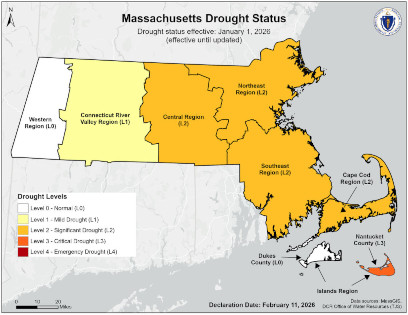
* The drought levels shown in the map above are in effect until the next drought declaration
Today, Energy and Environmental Affairs (EEA) Secretary Rebecca Tepper declared the Southeast Region has worsened to a Level-2 Significant Drought, and the Millers River Basin has improved. All other regions remain unchanged.
During January, Massachusetts received a significant amount of snow and a total of 2 to 3.5 inches of precipitation. In spite of this, precipitation deficits since 2024 remain. Additionally, record cold temperatures and frozen ground have prevented snowmelt from occurring and soaking into the soil, limiting groundwater recharge and discharge to streams.
Under a Level 2 (Significant Drought), all nonessential outdoor water uses remain banned, except the watering of ornamentals and flower gardens with drip irrigation. Hand-held hose or watering cans may be permitted.
The Cambridge Water Department carefully monitors the City’s water supply system on a weekly basis to ensure an adequate supply of water is available to meet the needs of our residents, businesses, and organizations.
For Level 2 – Significant Drought Status
In response to the ongoing drought, Cambridge has implemented strict water use restrictions.
All nonessential outdoor water use is currently prohibited, including:
- Private Residential Sprinkler Systems: Both above ground and installed underground sprinklers
- Filling pools
- Washing cars
- Pressure washing patios or sidewalks
Only outdoor water use deemed essential is allowed, such as for:
- Health and safety (e.g., firefighting, municipal pipe flushing, splash pads)
- Growing food, including vegetable gardens
- Core business functions
- Irrigation of public and private recreation fields (limited to off-peak hours – before 9 a.m. and after 5 p.m.)
- Golf course watering must also follow specific reductions during droughts, including reductions to irrigation of fairways and no watering of ornamentals during higher-level droughts.
- Private and Publicly funded shade trees and new lawn establishment post-construction
For a full list of essential uses, visit: Drought Status | Mass.gov
Residents, businesses and other organizations are encouraged to be mindful of water use and to help promote water conservation. This will help allow our water reservoir system to recharge, while maintaining water quality.
Residents and Businesses are strongly recommended to:
- Minimize overall water use
- Follow local water use restrictions
- Fix any toilet or faucet leaks immediately. Check for leaks in homes and businesses regularly by:
- Use the MA Home Water Use Calculator tool to evaluate household water use.
Aggressively reduce indoor water use by:
- Reducing shower length and consider using a shower timer
- Running washing machines only on a full load
- Not letting water run while brushing and shaving
- Replacing old fixtures and appliances with water-efficient ones. Make sure toilets, faucets, and showerheads are WaterSense labeled.
- You can conserve water in the kitchen, bathroom, laundry room, checking for leaks, and replacing appliances. Tips are available at Water Conservation - Water - City of Cambridge, Massachusetts.
Drought Ordinance and Enforcement Reminders
In January 2023, amendments to the Massachusetts Water Management Act were passed requiring all public water suppliers to establish enforceable restrictions limiting non-essential outdoor water use during any drought declarations by the Secretary of Energy and Environmental Affairs. On April 7, 2025, the Cambridge City Council’s Ordinance Committee ordained the proposed updates to the Cambridge Municipal Code (Chapters 13.08 and 13.12) to strengthen local drought response and enforcement. These amendments are aligned with state guidance under 310 CMR 36.00.
Key updates included:
- The City Manager or Managing Director of the Water Department must restrict non-essential outdoor water use during a state-declared drought.
- The Water Board may impose stricter restrictions than the state minimum if necessary.
- Enforceable Penalties for water ban violations were established.
ANY VIOLATION OF THE WATER USE RESTRICTIONS will now result in the following penalties:
- WARNING FOR 1ST VIOLATION
- $100 FINE FOR 2nd VIOLATION
- $200 FOR 3rd VIOLATION
- $300/PER DAY FOR EACH SUBSEQUENT VIOLATION
Violations may be enforced through criminal or noncriminal proceedings by designated City staff, police officers, or the Animal Commission.
Drought status updates will be published on the Water Department’s website, the City’s Daily Update newsletter, social media accounts, media outlets, and by other means reasonably calculated to reach and inform all users of water of the state of water supply conservation.
Additional Drought Related Resources
https://www.mass.gov/service-details/current-drought-status
https://www.drought.gov/drought/states/massachusetts
Current Drought Status for Cambridge = Level-2 Significant Drought
Per City Ordinance
All Nonessential Outdoor Water Uses are Banned
January 12, 2026:
*
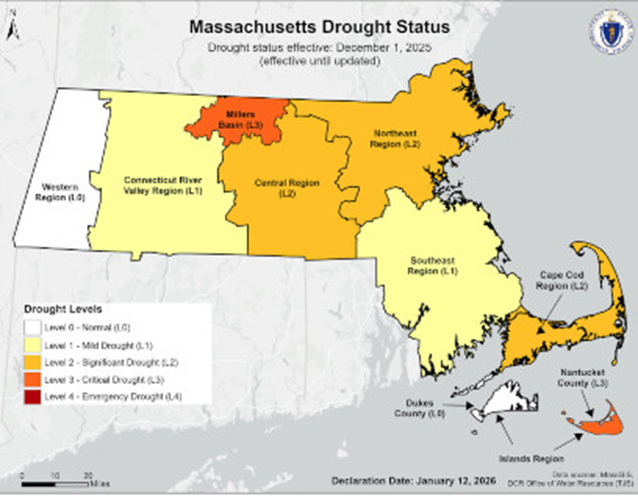
The drought levels shown in the map above are in effect until the next drought declaration
Today, Energy and Environmental Affairs (EEA) Secretary Rebecca Tepper declared that the Central and Northeast Regions have worsened to a Level 2–Significant Drought.
Under a Level 2 (Significant Drought), all nonessential outdoor water uses remain banned, except the watering of ornamentals and flower gardens with drip irrigation. Hand-held hose or watering cans may be permitted.
The Cambridge Water Department carefully monitors the City’s water supply system on a weekly basis to ensure an adequate supply of water is available to meet the needs of our residents, businesses, and organizations.
For Level 2 – Significant Drought Status
In response to the ongoing drought, Cambridge has implemented strict water use restrictions.
All nonessential outdoor water use is currently prohibited, including:
- Private Residential Sprinkler Systems: Both above ground and installed underground sprinklers
- Pressure washing patios or sidewalks
Only outdoor water use deemed essential is allowed, such as for:
- Health and safety (e.g., firefighting, municipal pipe flushing, splash pads)
- Growing food, including vegetable gardens
- Irrigation of public and private recreation fields (limited to off-peak hours – before 9 a.m. and after 5 p.m.)
- Golf course watering must also follow specific reductions during droughts, including reductions to irrigation of fairways and no watering of ornamentals during higher-level droughts.
- Private and Publicly funded shade trees and new lawn establishment post-construction
For a full list of essential uses, visit: Drought Status | Mass.gov
Residents, businesses and other organizations are encouraged to be mindful of water use and to help promote water conservation. This will help allow our water reservoir system to recharge, while maintaining water quality.
Residents and Businesses are strongly recommended to:
- Minimize overall water use
- Follow local water use restrictions
- Fix any toilet or faucet leaks immediately. Check for leaks in homes and businesses regularly by:
Aggressively reduce indoor water use by:
- Reducing shower length and consider using a shower timer
- Running washing machines only on a full load
- Not letting water run while brushing and shaving
- Replacing old fixtures and appliances with water-efficient ones. Make sure toilets, faucets, and showerheads are WaterSense labeled.
Drought Ordinance and Enforcement Reminders
In January 2023, amendments to the Massachusetts Water Management Act were passed requiring all public water suppliers to establish enforceable restrictions limiting non-essential outdoor water use during any drought declarations by the Secretary of Energy and Environmental Affairs. On April 7, 2025, the Cambridge City Council’s Ordinance Committee ordained the proposed updates to the Cambridge Municipal Code (Chapters 13.08 and 13.12) to strengthen local drought response and enforcement. These amendments are aligned with state guidance under 310 CMR 36.00.
Key updates included:
- The City Manager or Managing Director of the Water Department must restrict non-essential outdoor water use during a state-declared drought.
- The Water Board may impose stricter restrictions than the state minimum if necessary.
- Enforceable Penalties for water ban violations were established.
ANY VIOLATION OF THE WATER USE RESTRICTIONS will now result in the following penalties:
- WARNING FOR 1ST VIOLATION
- $100 FINE FOR 2nd VIOLATION
- $200 FOR 3rd VIOLATION
- $300/PER DAY FOR EACH SUBSEQUENT VIOLATION
Violations may be enforced through criminal or noncriminal proceedings by designated City staff, police officers, or the Animal Commission.
Drought status updates will be published on the Water Department’s website, the City’s Daily Update newsletter, social media accounts, media outlets, and by other means reasonably calculated to reach and inform all users of water of the state of water supply conservation.
Additional Drought Related Resources
https://www.mass.gov/service-details/current-drought-status
https://www.drought.gov/drought/states/massachusetts
Current Drought Status for Cambridge = Level-1 Mild Drought
December 10, 2025
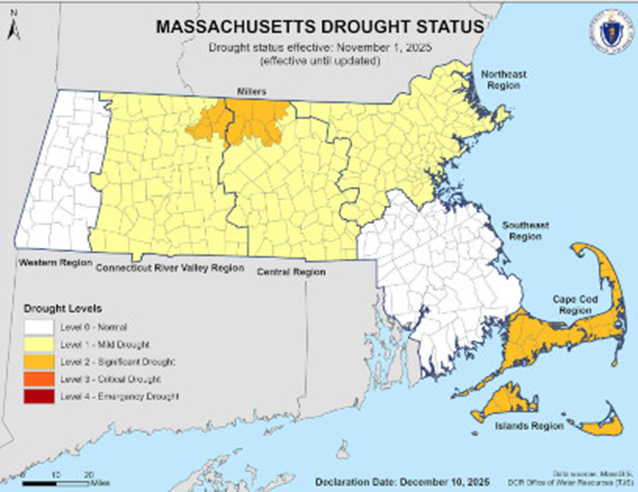
Today, Energy and Environmental Affairs (EEA) Secretary Rebecca Tepper declared the Western Region has returned to Normal Conditions. Drought levels remain unchanged throughout the rest of the Commonwealth with the Cape Cod and Islands Regions, and Millers Basin at a Level 2–Significant Drought; the Northeast, Central and Connecticut River Valley Regions at a Level 1–Mild Drought; and the Southeast Region at Normal Conditions.
During November, Massachusetts received rainfall ranging from 3 to 5 inches, with the Cape and Islands Regions seeing the highest totals. However, when looking back over the past 3 to 6 months, many areas still show deficits in precipitation. The forecasted rainfall is anticipated to bring relief to some regions of the state.
The current drought, which began in 2024, has had significant impacts on the natural environment, including the drying of streams in nearly all regions, lower water levels in lakes and ponds resulting in exposed banks, and impeding fish passage out to the ocean.
As outlined in the Massachusetts Drought Management Plan, a Level 1 – Mild Drought and Level 2 – Significant Drought require detailed monitoring of drought conditions. These levels also require ongoing coordination among state and federal agencies to implement drought response actions such as water use restrictions. Additionally, engagement with municipalities, including local Boards of Health (BOH), is essential. This includes providing technical outreach and assistance to water suppliers and affected municipalities. Residents are asked to report to their local BOH in case of wells drying up; BOHs are asked to report here on the condition of local private wells.
The Drought Management Task Force (DMTF) collected and analyzed data from August 2024 through October 2025. Residents can report dry environmental conditions and submit photos to help monitor the situation on the Massachusetts Water Impact Reporter (here). Additionally, a FAQ is now available for questions regarding the current drought status and water conservation; and private well owners can go here for information on how the drought may impact them.
State agencies will continue to closely monitor and assess conditions across the state, coordinate any needed dissemination of information to the public, and help federal, state, and local agencies prepare additional responses that may be needed in the future. The DMFT will meet again on Monday December 8th at 10 am. For further information on water conservation and what residents can do, visit the EEA’s drought and water conservation pages.
Below are recommendations for communities and individuals living and working within a Level 1 – Mild Drought and Level 2 – Significant Drought, including those utilizing a private well. Residents and businesses are strongly urged to check with their local water system in case more stringent watering restrictions are in place. Many systems may have other more severe local conditions and constraints on water supply.
For Regions in Level 1 – Mild Drought
Residents and Businesses:
- Minimize overall water use;
- Limit outdoor watering to one day per week from 5:00 PM to 9:00 AM, or less frequently if required by your water supplier;
- Plant only local and drought-resistant species;
- Fix indoor leaks, such as from toilets, faucets, and showers, which result in more than 60 percent of indoor use;
- For larger buildings and businesses, conduct water audits to identify areas of leaks and potential water conservation opportunities;
- Minimize lawn sizes; and,
- Harvest rainwater for outdoor watering.
Communities:
- Establish a year-round water conservation program that includes public education and communication, taking advantage of the state’s library of outreach materials;
- Provide timely drought and water conservation information to residents and businesses;
- Check emergency inter-connections for water supply; and
- Develop a local drought management plan (learn more here).
Drought status updates will be published on the Water Department’s website, the City’s Daily Update newsletter, social media accounts, media outlets, and by other means reasonably calculated to reach and inform all users of water of the state of water supply conservation.
Additional Drought Related Resources
https://www.mass.gov/service-details/current-drought-status
https://www.drought.gov/drought/states/massachusetts
Current Drought Status for Cambridge = Level-1 Mild Drought
November 7, 2025
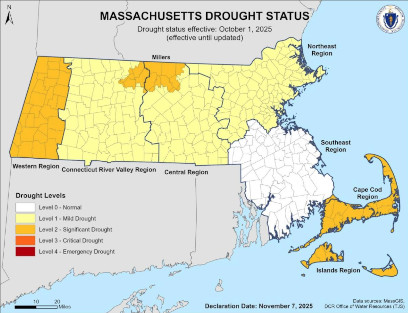
Today, Energy and Environmental Affairs (EEA) Secretary Rebecca Tepper declared the Southeast Region has returned to Normal Conditions. The Connecticut River Valley and Central Regions have improved to Level 1 – Mild Drought. In the Islands Region, Nantucket has improved, while Martha’s Vinyard has worsened, both now at a Level 2 – Significant Drought. The Deerfield Watershed improved to Level 1 – Mild Drought, and the Millers Watershed improved to Level 2 – Significant Drought. The Northeast, Cape Cod and Western Regions remain unchanged.
During October, Massachusetts received rainfall ranging from 3 to 10 inches, with the Southeast Region seeing the highest totals. However, when looking back over the past 3 to 6 months, many areas still show deficits in precipitation. The forecasted rainfall will continue to bring relief to most regions of the state.
The current drought, which began in 2024, has had significant impacts on the natural environment, including the drying of streams in nearly all regions, lower water levels in lakes and ponds resulting in exposed banks, and impeding fish passage out to the ocean.
As outlined in the Massachusetts Drought Management Plan, a Level 1 – Mild Drought and Level 2 – Significant Drought require detailed monitoring of drought conditions. These levels also require ongoing coordination among state and federal agencies to implement drought response actions such as water use restrictions. Additionally, engagement with municipalities, including local Boards of Health (BOH), is essential. This includes providing technical outreach and assistance to water suppliers and affected municipalities. Residents are asked to report to their local BOH in case of wells drying up; BOHs are asked to report here on the condition of local private wells.
The Drought Management Task Force (DMTF) collected and analyzed data from August 2024 through October 2025. Residents can report dry environmental conditions and submit photos to help monitor the situation on the Massachusetts Water Impact Reporter (here). Additionally, a FAQ is now available for questions regarding the current drought status and water conservation; and private well owners can go here for information on how the drought may impact them.
State agencies will continue to closely monitor and assess conditions across the state, coordinate any needed dissemination of information to the public, and help federal, state, and local agencies prepare additional responses that may be needed in the future. The DMFT will meet again on Monday December 8th at 10 am. For further information on water conservation and what residents can do, visit the EEA’s drought and water conservation pages.
Below are recommendations for communities and individuals living and working within a Level 1 – Mild Drought and Level 2 – Significant Drought, including those utilizing a private well. Residents and businesses are strongly urged to check with their local water system in case more stringent watering restrictions are in place. Many systems may have other more severe local conditions and constraints on water supply.
For Regions in Level 1 – Mild Drought
Residents and Businesses:
- Minimize overall water use;
- Limit outdoor watering to one day per week from 5:00 PM to 9:00 AM, or less frequently if required by your water supplier;
- Plant only local and drought-resistant species;
- Fix indoor leaks, such as from toilets, faucets, and showers, which result in more than 60 percent of indoor use;
- For larger buildings and businesses, conduct water audits to identify areas of leaks and potential water conservation opportunities;
- Minimize lawn sizes; and,
- Harvest rainwater for outdoor watering.
Communities:
- Establish a year-round water conservation program that includes public education and communication, taking advantage of the state’s library of outreach materials;
- Provide timely drought and water conservation information to residents and businesses;
- Check emergency inter-connections for water supply; and
- Develop a local drought management plan (learn more here).
Drought status updates will be published on the Water Department’s website, the City’s Daily Update newsletter, social media accounts, media outlets, and by other means reasonably calculated to reach and inform all users of water of the state of water supply conservation.
Additional Drought Related Resources
https://www.mass.gov/service-details/current-drought-status
https://www.drought.gov/drought/states/massachusetts
Current Drought Status for Cambridge = Level-1 Mild Drought
October 10, 2025
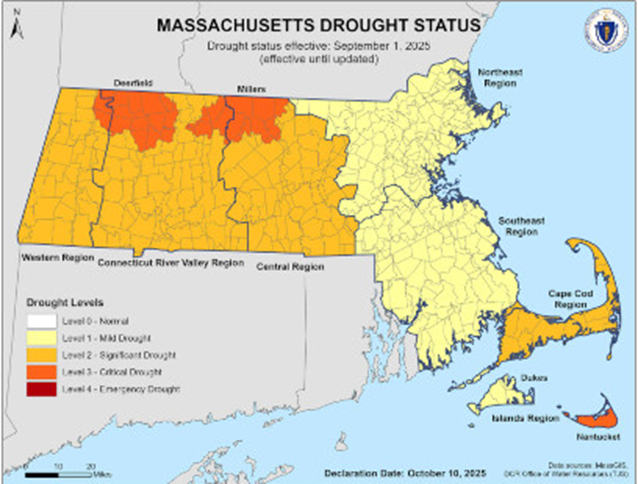
Today, Energy and Environmental Affairs (EEA) Secretary Rebecca Tepper declared that the Northeast Region has improved from Level 2–Significant Drought to Level 1–Mild Drought.
During September, Massachusetts received between 2 - 6 inches of rainfall. Three-month precipitation totals are now generally 40–80% of normal across Massachusetts. Six-month totals remain within 20% of normal across most of the state,
The current drought has caused many impacts to the natural environment including the drying of streams in nearly all regions, lower water levels in lakes and ponds resulting in exposed banks, and the impediment of fish passage out to the ocean. Local water supplies have been impacted with many cities and towns instituting watering restrictions to ensure long-term sustainability.
State agencies will continue to closely monitor and assess conditions across the state, coordinate any needed dissemination of information to the public, and help federal, state, and local agencies prepare additional responses that may be needed in the future. The DMTF will meet again on Thursday, November 6th at 10:00 AM. For further information on water conservation and what residents can do, visit the EEA’s drought and water conservation pages.
Below are recommendations for communities and individuals living and working within a Level 1 – Mild Drought, Level 2 – Significant Drought, and Level 3 – Critical Drought including those utilizing a private well. Residents and businesses are strongly urged to check with their local water system in case more stringent watering restrictions are in place. Many systems may have other more severe local conditions and constraints on water supply.
For Regions in Level 1 – Mild Drought
Residents and Businesses:
- Minimize overall water use;
- Limit outdoor watering to one day per week from 5:00 PM to 9:00 AM, or less frequently if required by your water supplier;
- Plant only local and drought-resistant species;
- Fix indoor leaks, such as from toilets, faucets, and showers, which result in more than 60 percent of indoor use;
- For larger buildings and businesses, conduct water audits to identify areas of leaks and potential water conservation opportunities;
- Minimize lawn sizes; and,
- Harvest rainwater for outdoor watering.
Communities:
- Establish a year-round water conservation program that includes public education and communication, taking advantage of the state’s library of outreach materials;
- Provide timely drought and water conservation information to residents and businesses;
- Check emergency inter-connections for water supply; and
- Develop a local drought management plan (learn more here).
Drought status updates will be published on the Water Department’s website, the City’s Daily Update newsletter, social media accounts, media outlets, and by other means reasonably calculated to reach and inform all users of water of the state of water supply conservation.
Additional Drought Related Resources
https://www.mass.gov/service-details/current-drought-status
https://www.drought.gov/drought/states/massachusetts
Current Drought Status for Cambridge = Level-2 Significant Drought
Per City Ordinance
All Nonessential Outdoor Water Uses are Banned
September 9, 2025:
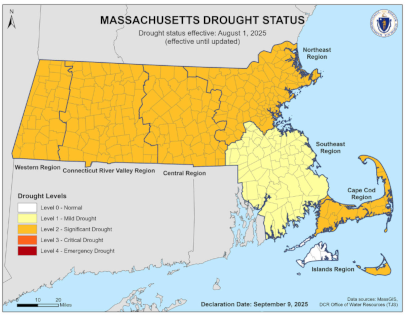
* The drought levels shown in the map above are in effect until the next drought declaration
Today, Energy and Environmental Affairs (EEA) Secretary Rebecca Tepper declared that drought in the Western, Connecticut River Valley, Central, Northeast Regions and Nantucket County has worsened to a Level-2 Significant Drought.
Under a Level 2 (Significant Drought), all nonessential outdoor water uses remain banned, except the watering of ornamentals and flower gardens with drip irrigation. Hand-held hose or watering cans may be permitted.
The Cambridge Water Department carefully monitors the City’s water supply system on a weekly basis to ensure an adequate supply of water is available to meet the needs of our residents, businesses, and organizations.
For Level 2 – Significant Drought Status
In response to the ongoing drought, Cambridge has implemented strict water use restrictions.
All nonessential outdoor water use is currently prohibited, including:
- Private Residential Sprinkler Systems: Both above ground and installed underground sprinklers
- Filling pools
- Washing cars
- Pressure washing patios or sidewalks
Only outdoor water use deemed essential is allowed, such as for:
- Health and safety (e.g., firefighting, municipal pipe flushing, splash pads)
- Growing food, including vegetable gardens
- Core business functions
- Irrigation of public and private recreation fields (limited to off-peak hours – before 9 a.m. and after 5 p.m.)
- Golf course watering must also follow specific reductions during droughts, including reductions to irrigation of fairways and no watering of ornamentals during higher-level droughts.
- Private and Publicly funded shade trees and new lawn establishment post-construction
For a full list of essential uses, visit: Drought Status | Mass.gov
Residents, businesses and other organizations are encouraged to be mindful of water use and to help promote water conservation. This will help allow our water reservoir system to recharge, while maintaining water quality.
Residents and Businesses are strongly recommended to:
- Minimize overall water use
- Follow local water use restrictions
- Fix any toilet or faucet leaks immediately. Check for leaks in homes and businesses regularly by:
- Use the MA Home Water Use Calculator tool to evaluate household water use.
Aggressively reduce indoor water use by:
- Reducing shower length and consider using a shower timer
- Running washing machines only on a full load
- Not letting water run while brushing and shaving
- Replacing old fixtures and appliances with water-efficient ones. Make sure toilets, faucets, and showerheads are WaterSense labeled.
- You can conserve water in the kitchen, bathroom, laundry room, checking for leaks, and replacing appliances. Tips are available at Water Conservation - Water - City of Cambridge, Massachusetts.
Drought Ordinance and Enforcement Reminders
In January 2023, amendments to the Massachusetts Water Management Act were passed requiring all public water suppliers to establish enforceable restrictions limiting non-essential outdoor water use during any drought declarations by the Secretary of Energy and Environmental Affairs. On April 7, 2025, the Cambridge City Council’s Ordinance Committee ordained the proposed updates to the Cambridge Municipal Code (Chapters 13.08 and 13.12) tostrengthen local drought response and enforcement. These amendments are aligned with state guidance under 310 CMR 36.00.
Key updates included:
- The City Manager or Managing Director of the Water Department must restrict non-essential outdoor water use during a state-declared drought.
- The Water Board may impose stricter restrictions than the state minimum if necessary.
- Enforceable Penalties for water ban violations were established.
ANY VIOLATION OF THE WATER USE RESTRICTIONS will now result in the following penalties:
- WARNING FOR 1ST VIOLATION
- $100 FINE FOR 2nd VIOLATION
- $200 FOR 3rd VIOLATION
- $300/PER DAY FOR EACH SUBSEQUENT VIOLATION
Violations may be enforced through criminal or noncriminal proceedings by designated City staff, police officers, or the Animal Commission.
Drought status updates will be published on the Water Department’s website, the City’s Daily Update newsletter, social media accounts, media outlets, and by other means reasonably calculated to reach and inform all users of water of the state of water supply conservation.
Additional Drought Related Resources
https://www.mass.gov/service-details/current-drought-status
https://www.drought.gov/drought/states/massachusetts
Current Drought Status for Cambridge 0 = Normal Conditions
August 8, 2025:
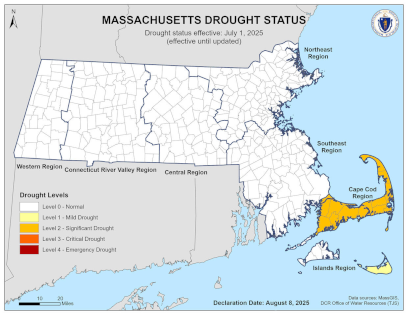
* The drought levels shown in the map above are in effect until the next drought declaration
Today, Energy and Environmental Affairs (EEA) Secretary Rebecca Tepper declared theCape Cod Region has been upgraded to a Level 2 – Significant Drought from a Level 1 – Mild Drought last month. The Southeast, Connecticut River Valley, Western, Central, and Northeast Regions remain at Normal Conditions, although conditions are starting to dry all across the state. Nantucket County is currently at a Level 1 – Mild Drought, while Dukes County remains at Normal Conditions within the Islands Regions.
Additional Drought Related Resources
https://www.mass.gov/service-details/current-drought-status
https://www.drought.gov/drought/states/massachusetts
Current Drought Status for Cambridge 0 = Normal Conditions
June 10, 2025:
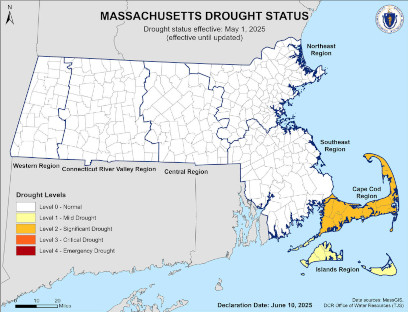
* The drought levels shown in the map above are in effect until the next drought declaration
Today, Energy and Environmental Affairs (EEA) Secretary Rebecca Tepper declared theSoutheast Region has been downgraded to Level 0 – Normal Conditions, joining the Connecticut River Valley, Western, Central, and Northeast Regions. The Islands Region remains at Level 1 – Mild Drought, while the Cape Cod Region continues at Level 2 – Significant Drought.
Additional Drought Related Resources
https://www.mass.gov/service-details/current-drought-status
https://www.drought.gov/drought/states/massachusetts
May 20, 2025:
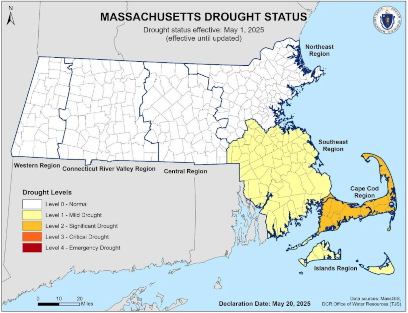
* The drought levels shown in the map above are in effect until the next drought declaration
Today, Energy and Environmental Affairs (EEA) Secretary Rebecca Tepper declared theConnecticut River Valley, Western and Northeast Regions have been downgraded to Level 0-Normal Conditions, joining the Central Region. The Islands and Southeast Regions remain at Level 1 - Mild Drought, while the Cape Cod Region continues at Level 2 - Significant Drought.
Additional Drought Related Resources
https://www.mass.gov/service-details/current-drought-status
https://www.drought.gov/drought/states/massachusetts
Current Drought Status for Cambridge = Level 1 - Mild Drought
May 9, 2025:
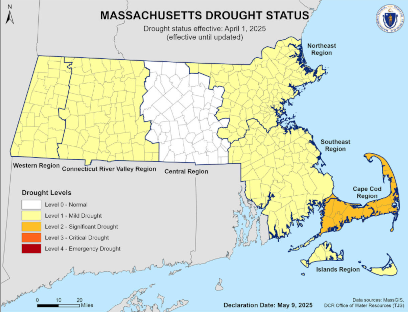
Today, Energy and Environmental Affairs (EEA) Secretary Rebecca Tepper declared theCentral Region will be downgraded from a Level 1-Mild Drought to Level 0-Normal Conditions. The Northeast and Islands Regions were also lowered to a Level 1 – Mild Drought, joining the Connecticut River Valley, Southeast, and Western Regions. The Cape Cod Region remains at a Level 2 – Significant Drought.
Recent rains have been extremely helpful in alleviating long-term dry conditions. To ensure a system wide recovery from drought a substantial amount of precipitation is needed, in addition to increased groundwater levels. As outlined in the Massachusetts Drought Management Plan, a Level 1 – Mild Drought and a Level – 2 Significant Drought require detailed monitoring of drought conditions. These levels also require ongoing coordination among state and federal agencies to implement drought response actions such as water use restrictions. Additionally, engagement with municipalities, including local Boards of Health, is essential. This includes providing technical outreach and assistance to water suppliers and affected municipalities.
State agencies will continue to closely monitor and assess conditions across the state, coordinate any needed dissemination of information to the public, and help federal, state, and local agencies prepare additional responses that may be needed in the future. The Drought Management Task Force will meet again on Monday, June 9 at 1:00 pm. For further information on water conservation and what residents can do, visit the EEA’s drought and water conservation pages.
Below are recommendations for communities and individuals living and working within a Level 1 – Mild Drought and Level 2 – Significant Drought including those utilizing a private well. Residents and businesses are also asked to check with their local water system in case more stringent watering restrictions are in place.
For Regions in Level 1 – Mild Drought
Residents and Businesses:
- Minimize overall water use;
- Limit outdoor watering to one day per week from 5:00 PM to 9:00 AM, or less frequently if required by your water supplier;
- Plant only local and drought-resistant species;
- Fix indoor leaks, such as from toilets, faucets, and showers, which result in more than 60 percent of indoor use;
- For larger buildings and businesses, conduct water audits to identify areas of leaks and potential water conservation opportunities;
- Minimize lawn sizes; and,
- Harvest rainwater for outdoor watering.
Communities:
- Establish a year-round water conservation program that includes public education and communication, taking advantage of the state’s library of outreach materials;
- Provide timely drought and water conservation information to residents and businesses;
- Check emergency inter-connections for water supply; and
- Develop a local drought management plan (learn more here).
Additional Drought Related Resources
https://www.mass.gov/service-details/current-drought-status
https://www.drought.gov/drought/states/massachusetts
Current Drought Status for Cambridge = Level-2 Significant Drought - All Nonessential Outdoor Water Uses are Banned
April 9, 2025:
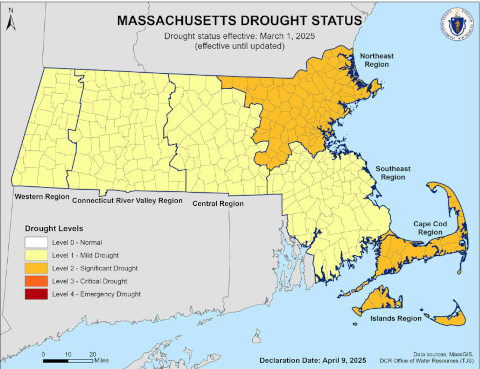
Energy and Environmental Affairs (EEA) Secretary Rebecca Tepper declared the Connecticut River Valley, Central, Southeast and Western regions of the state have been downgraded to a Level 1 – Mild Drought status following two months of above normal precipitation. The Northeast Region will join the Cape and Islands regions at a Level 2 – Significant Drought.
Above-average precipitation over the last couple of months has helped improve streamflow and raise groundwater levels in several regions. However, drought conditions are still affecting the regions in the eastern part of the state due to ongoing precipitation deficits. In most regions of the state, monthly precipitation has generally ranged from around 4 to 6 inches. Over the past three months, precipitation has been near-normal across Central and Northeastern regions, while the Cape and Islands regions have experienced 40 percent below average precipitation for the past six months. The data collected by the Drought Management Task Force (DMTF) reflects the observations made from the start of the drying conditions in August 2024 through the end of March 2025. Residents can report dry environmental conditions they are experiencing and submit photos to support state drought monitoring efforts here.
As outlined in the Massachusetts Drought Management Plan, a Level 1 – Mild Drought, and a Level – 2 Significant Drought require detailed monitoring of drought conditions. These levels also require ongoing coordination among state and federal agencies to implement drought response actions such as water use restrictions. Additionally, engagement with municipalities, including local Boards of Health, is essential. This includes providing technical outreach and assistance to water suppliers and affected municipalities.
The Drought Management Task Force will meet again on Wednesday, May 7 and will update recommendations as necessary. For further information on water conservation and what residents can do, visit the EEA’s drought and water conservation pages.
Level 2 – Significant Drought
Per State regulations ALL NONESSENTIAL OUTDOOR WATER USES ARE BANNED except that watering of ornamentals and flower gardens with drip irrigation, hand-held hose or watering cans may be permitted
Additionally the State has issued the following recommendations for Residents and Businesses:
- Minimize overall water use
- Follow local water use restrictions
- Fix any toilet or faucet leaks immediately
- Aggressively reduce indoor water use by taking shorter showers, running dishwashers and washing machines only on a full load
WATER MANAGEMENT ACT (WMA) REVISIONS – Effective January 20, 2023
Nonessential Outdoor Water Use - State Drought Level Water Restrictions
Per Massachusetts 310 CMR 36.07 (2) (c)
Restrictions on Nonessential Outdoor Water Use as follows:
l. For withdrawals not described in 310 CMR 36.07(2)©2 or 3., as soon as possible but no later than 24 months an issuance of the registration statement, the registrant shall establish enforceable restrictions limiting nonessential outdoor water use, Such restrictions shall be in place during a drought declaration by the Secretary for the drought region, county or watershed where the registrant's withdrawals are located, and nonessential outdoor water use shall be restricted as follows:
- Level I (Mild All nonessential outdoor water uses restricted to no more than one day per week, before 9:00 A.M. and after 5:00 P.M., except that watering of ornamentals and flower gardens with drip irrigation, hand-held hose or watering cans may be permitted.
- Level 2 (Significant Drought), All nonessential outdoor water uses banned, except that watering of ornamentals and flower gardens with drip irrigation, hand-held hose or watering cans may be permitted,
- Level 3 (Critical Drought) or Level 4 (Drought Emergency). All nonessential outdoor water uses are banned.
2. For withdrawals for the maintenance of golf course greens, tees, fairways, and roughs during a drought declaration by the Secretary for the drought region, county or watershed where the registration withdrawals are located. registrants shall comply with the following restrictions on nonessential outdoor water use:
- Level 1 (Mild Drought). Irrigation of fairways shall be reduced to 80% normal, irrigation of roughs shall be reduced to 50% of normal, and there shall be no irrigation of landscaping and ornamentals,
- Level 2 (Significant Drought). Irrigation of fairways shall be reduced to 60% normal, and there shall be no irrigation of roughs, landscaping and ornamentals.
- Level 3 (Critical Drought) or Level 4 (Drought Emergency). Irrigation of fairways shall be reduced to 40% of normal, and there shall be no irrigation of roughs, landscaping and ornamentals.
The Water Management Program regulations, effective January 20, 2023, define nonessential outdoor water use as every use that is not required for essential purposes (310 CMR 36.02).
NONESSENTIAL OUTDOOR WATER USE RESTRICTIONS
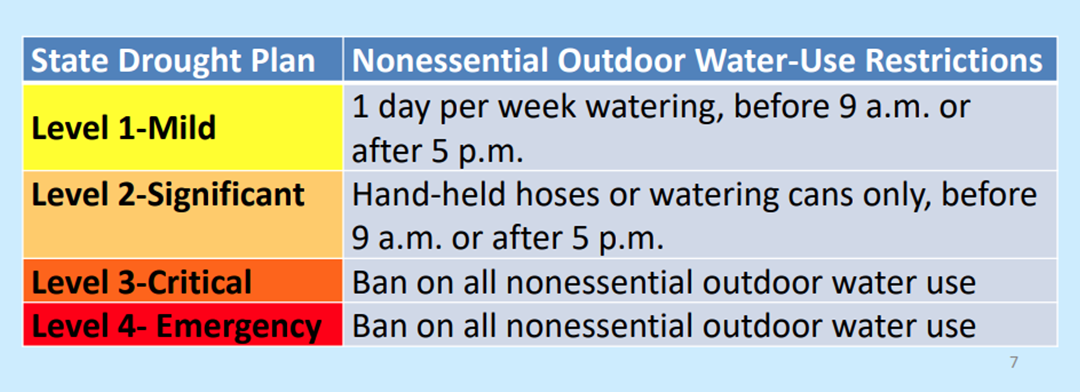
The following is a list of outdoor water uses identified in the regulations that will not be restricted under the new conditions in the Massachusetts Water Management Act
(a) health or safety - includes outdoor uses like fire-fighting and municipal pipe flushing to prevent contaminants in water supply pipes, as well as
• public facilities used for cooling such as splash pads and swimming pools
• for washing of boats, engines, or marine equipment to prevent negative saltwater impacts or the transfer of invasive aquatic species
(b) by permit, license, statute or regulation;
(c) for the production of food, including vegetable gardens, and fiber
(d) for maintenance of livestock;
(e) to meet the core functions (those functions essential to the commercial operations) of a business,
(f) for irrigation of public parks before 9:00 a.m. and after 5:00 p.m.,
(g) for irrigation of public and private recreation fields, including those operated by schools, colleges, universities and athletic associations, before 9:00 a.m. and after 5:00 p.m.,
(h) for irrigation of publicly funded shade trees and trees in the public right-of-way;
(i) to establish a new lawn as necessary to stabilize soil in response to new construction or following the repair or replacement of a Title 5 system.
(For a more detailed description of non-restricted essential water uses refer to the, Mass DEP Guidance on Nonessential Outdoor Water Use document included below.
Golf courses are considered exempt and allowed to water as necessary to maintain greens and tees, and limited fairway watering per 310 CMR 36.07(2)(c)2.a. through c.; as summarized in the Mass DEP figure 1 below;
Figure 1 – Mass DEP Golf Course Watering Restrictions
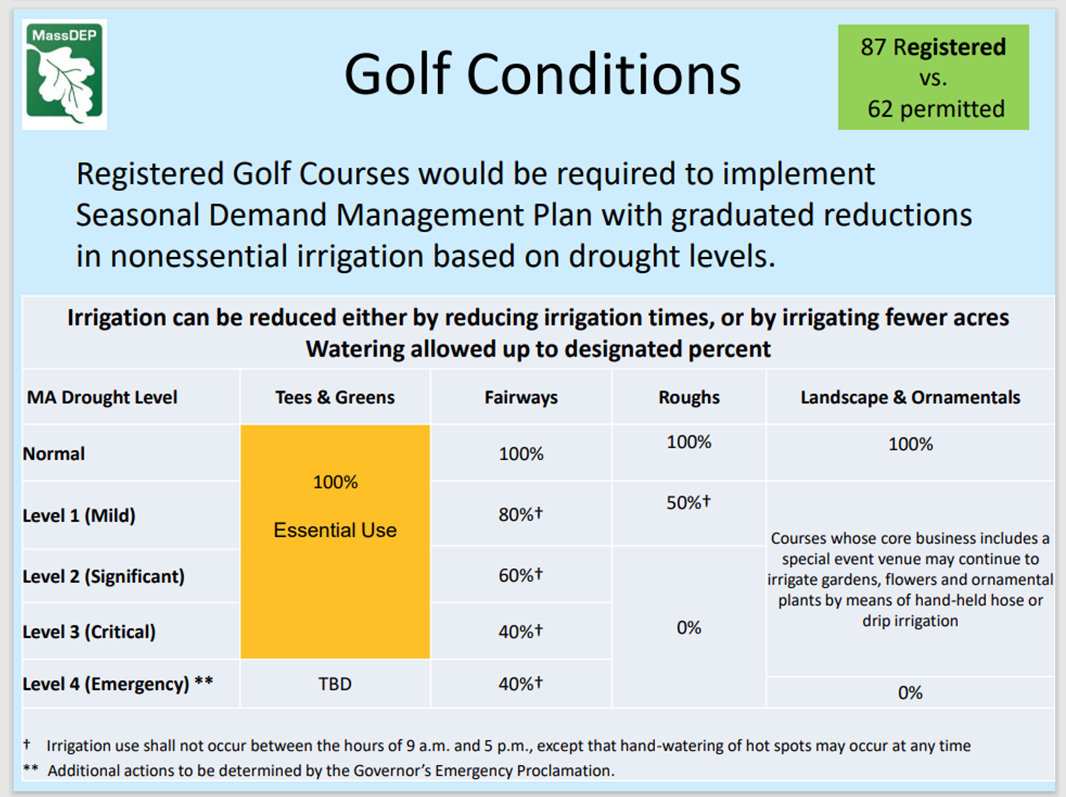
As of January 20, 2023 MassDEP revised sections of its Water Management Act Regulations, 310 CMR 36.00. In Cambridge, this now means that a new condition has been imposed that requires the City to restrict "nonessential outdoor water use" during times of drought declared by the Secretary of Energy and Environmental Affairs.
All nonessential water use restrictions are discussed in section 36.07 Registration Conditions and depend on the level of drought declared.
For more information about the state Water Management Act, Water Resources Management Program, and Regulations, see below links
https://malegislature.gov/Laws/GeneralLaws/PartI/TitleII/Chapter21G
https://www.mass.gov/water-management-act-program
https://www.mass.gov/regulations/310-CMR-3600-massachusetts-water-resources-management-program
Additional Drought Related Resources
https://www.mass.gov/service-details/current-drought-status
https://www.drought.gov/drought/states/massachusetts
Current Drought Status for Cambridge = Level-3 Critical Drought - All Nonessential Outdoor Water Uses are Banned
March 7, 2025:
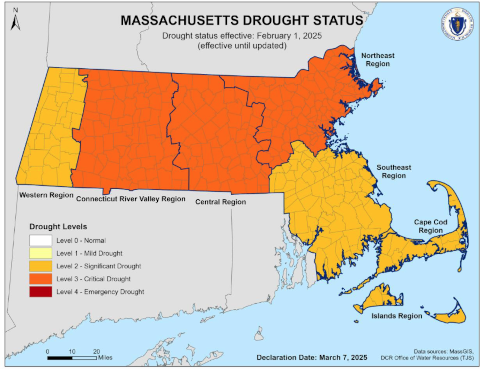
Following nearly seven months of below-normal precipitation, Energy and Environmental Affairs (EEA) Secretary Rebecca Tepper declared the Connecticut River Valley region has been raised to a Level – 3 Critical Drought. The Western region has been raised to a Level – 2 Significant Drought. Critical and Significant drought conditions persist in all other regions across the state.
Over the past month, most of the state received between 2-4 inches of rain and snow which is 1-1.5 inches below normal. The data collected by the Drought Management Task Force (DMTF) reflects the observations made from the start of the drying conditions in August 2024 through the end of February. Overall, most of the state is in an 8-13 inches deficit since August, with the Cape and Islands at 5-8 inches deficit. Despite temporary surges in streamflow from recent precipitation events, streamflow and groundwater have worsened in nearly all regions, and recharge that typically occurs at this time of the year to reservoirs and groundwater is diminished. The presence of ice in the streams continues to prevent computations of streamflow at several gages in the western part of the state. Where we have streamflow data, streamflow conditions were mainly below to much below normal across the State, except a few locations in the southeast region. Residents can report dry environmental conditions they are experiencing and submit photos to support state drought monitoring efforts here.
As outlined in the Massachusetts Drought Management Plan, a Level 3 – Critical Drought, and a Level – 2 Significant Drought require detailed monitoring of drought conditions. These levels also require ongoing coordination among state and federal agencies to implement drought response actions such as water use restrictions. Additionally, engagement with municipalities, including local Boards of Health, is essential. This includes providing technical outreach and assistance to water suppliers and affected municipalities.
Below are recommendations for communities and individuals living and working within a Level 3 – Critical Drought and Level 2 – Significant Drought including those utilizing a private well. Residents and businesses are also asked to check with their local water system in case more stringent watering restrictions are in place.
State agencies will continue to closely monitor and assess conditions across the state, coordinate any needed dissemination of information to the public, and help federal, state, and local agencies prepare additional responses that may be needed in the future. The Drought Management Task Force will meet again on Tuesday, April 8 at 10:00 AM. For further information on water conservation and what residents can do, visit the EEA’s drought and water conservation pages.
Level 3 – Critical Drought
Per State regulations ALL NONESSENTIAL OUTDOOR WATER USES ARE BANNED.
Additionally the State has issued the following recommendations for Residents and Businesses:
- Minimize overall water use
- Follow local water use restrictions
- Fix any toilet or faucet leaks immediately
- Aggressively reduce indoor water use by taking shorter showers, running dishwashers and washing machines only on a full load
WATER MANAGEMENT ACT (WMA) REVISIONS – Effective January 20, 2023
Nonessential Outdoor Water Use - State Drought Level Water Restrictions
Per Massachusetts 310 CMR 36.07 (2) (c)
Restrictions on Nonessential Outdoor Water Use as follows:
l. For withdrawals not described in 310 CMR 36.07(2)©2 or 3., as soon as possible but no later than 24 months an issuance of the registration statement, the registrant shall establish enforceable restrictions limiting nonessential outdoor water use, Such restrictions shall be in place during a drought declaration by the Secretary for the drought region, county or watershed where the registrant's withdrawals are located, and nonessential outdoor water use shall be restricted as follows:
- Level I (Mild All nonessential outdoor water uses restricted to no more than one day per week, before 9:00 A.M. and after 5:00 P.M., except that watering of ornamentals and flower gardens with drip irrigation, hand-held hose or watering cans may be permitted.
- Level 2 (Significant Drought), All nonessential outdoor water uses banned, except that watering of ornamentals and flower gardens with drip irrigation, hand-held hose or watering cans may be permitted,
- Level 3 (Critical Drought) or Level 4 (Drought Emergency). All nonessential outdoor water uses are banned.
2. For withdrawals for the maintenance of golf course greens, tees, fairways, and roughs during a drought declaration by the Secretary for the drought region, county or watershed where the registration withdrawals are located. registrants shall comply with the following restrictions on nonessential outdoor water use:
- Level 1 (Mild Drought). Irrigation of fairways shall be reduced to 80% normal, irrigation of roughs shall be reduced to 50% of normal, and there shall be no irrigation of landscaping and ornamentals,
- Level 2 (Significant Drought). Irrigation of fairways shall be reduced to 60% normal, and there shall be no irrigation of roughs, landscaping and ornamentals.
- Level 3 (Critical Drought) or Level 4 (Drought Emergency). Irrigation of fairways shall be reduced to 40% of normal, and there shall be no irrigation of roughs, landscaping and ornamentals.
The Water Management Program regulations, effective January 20, 2023, define nonessential outdoor water use as every use that is not required for essential purposes (310 CMR 36.02).
NONESSENTIAL OUTDOOR WATER USE RESTRICTIONS
The following is a list of outdoor water uses identified in the regulations that will not be restricted under the new conditions in the Massachusetts Water Management Act
(a) health or safety - includes outdoor uses like fire-fighting and municipal pipe flushing to prevent contaminants in water supply pipes, as well as
• public facilities used for cooling such as splash pads and swimming pools
• for washing of boats, engines, or marine equipment to prevent negative saltwater impacts or the transfer of invasive aquatic species
(b) by permit, license, statute or regulation;
(c) for the production of food, including vegetable gardens, and fiber
(d) for maintenance of livestock;
(e) to meet the core functions (those functions essential to the commercial operations) of a business,
(f) for irrigation of public parks before 9:00 a.m. and after 5:00 p.m.,
(g) for irrigation of public and private recreation fields, including those operated by schools, colleges, universities and athletic associations, before 9:00 a.m. and after 5:00 p.m.,
(h) for irrigation of publicly funded shade trees and trees in the public right-of-way;
(i) to establish a new lawn as necessary to stabilize soil in response to new construction or following the repair or replacement of a Title 5 system.
(For a more detailed description of non-restricted essential water uses refer to the, Mass DEP Guidance on Nonessential Outdoor Water Use document included below.
Golf courses are considered exempt and allowed to water as necessary to maintain greens and tees, and limited fairway watering per 310 CMR 36.07(2)(c)2.a. through c.; as summarized in the Mass DEP figure 1 below;
Figure 1 – Mass DEP Golf Course Watering Restrictions
As of January 20, 2023 MassDEP revised sections of its Water Management Act Regulations, 310 CMR 36.00. In Cambridge, this now means that a new condition has been imposed that requires the City to restrict "nonessential outdoor water use" during times of drought declared by the Secretary of Energy and Environmental Affairs.
All nonessential water use restrictions are discussed in section 36.07 Registration Conditions and depend on the level of drought declared.
For more information about the state Water Management Act, Water Resources Management Program, and Regulations, see below links
https://malegislature.gov/Laws/GeneralLaws/PartI/TitleII/Chapter21G
https://www.mass.gov/water-management-act-program
https://www.mass.gov/regulations/310-CMR-3600-massachusetts-water-resources-management-program
Additional Drought Related Resources
https://www.mass.gov/service-details/current-drought-status
https://www.drought.gov/drought/states/massachusetts
February 7, 2025:

Following several weeks of below-normal precipitation, Energy and Environmental Affairs (EEA) Secretary Rebecca Tepper declared theCentral and Northeast regions have been raised to a Level – 3 Critical Drought. The Southeast, Cape and Islands regions have been elevated to a Level – 2 Significant Drought. The Connecticut River Valley and Western regions still have their previous statuses: Level 2 – Significant and Level – 1 Mild Drought.
Over the past month, rainfall totals for most of the state were between 8-13 inches below normal. The Cape and Islands region is experiencing a 3.8-6 inch deficit in precipitation. Despite the recent rain and snowfall, streamflow and groundwater have worsened in nearly all regions. Residents can report dry environmental conditions they are experiencing and submit photos to support state drought monitoring efforts here.
As outlined in the Massachusetts Drought Management Plan, a Level 3 – Critical Drought, Level – 2 Significant Drought, and a Level – 1 Mild Drought require detailed monitoring of drought conditions. These levels also require ongoing coordination among state and federal agencies to implement water use restrictions. Additionally, engagement with municipalities, including local Boards of Health, is essential. This includes providing technical outreach and assistance to water suppliers and affected municipalities.
The Drought Management Task Force will meet next month and will update recommendations, as necessary.
Below are recommendations for communities and individuals living and working within Level 1 – Mild Drought, Level 2 – Significant Drought, and Level 3 – Critical Drought Regions, including those utilizing a private well. Residents and businesses are also asked to check with their local water system in case more stringent watering restrictions are in place:
For Region in Level 3 – Critical Drought
Per State regulations ALL NONESSENTIAL OUTDOOR WATER USES ARE BANNED.
Additionally the State has issued the following recommendations for Residents and Businesses:
- Minimize overall water use
- Follow local water use restrictions
- Fix any toilet or faucet leaks immediately
- Aggressively reduce indoor water use by taking shorter showers, running dishwashers and washing machines only on a full load
WATER MANAGEMENT ACT (WMA) REVISIONS – Effective January 20, 2023
Nonessential Outdoor Water Use - State Drought Level Water Restrictions
Per Massachusetts 310 CMR 36.07 (2) (c)
Restrictions on Nonessential Outdoor Water Use as follows:
l. For withdrawals not described in 310 CMR 36.07(2)©2 or 3., as soon as possible but no later than 24 months an issuance of the registration statement, the registrant shall establish enforceable restrictions limiting nonessential outdoor water use, Such restrictions shall be in place during a drought declaration by the Secretary for the drought region, county or watershed where the registrant's withdrawals are located, and nonessential outdoor water use shall be restricted as follows:
- Level I (Mild All nonessential outdoor water uses restricted to no more than one day per week, before 9:00 A.M. and after 5:00 P.M., except that watering of ornamentals and flower gardens with drip irrigation, hand-held hose or watering cans may be permitted.
- Level 2 (Significant Drought), All nonessential outdoor water uses banned, except that watering of ornamentals and flower gardens with drip irrigation, hand-held hose or watering cans may be permitted,
- Level 3 (Critical Drought) or Level 4 (Drought Emergency). All nonessential outdoor water uses are banned.
2. For withdrawals for the maintenance of golf course greens, tees, fairways, and roughs during a drought declaration by the Secretary for the drought region, county or watershed where the registration withdrawals are located. registrants shall comply with the following restrictions on nonessential outdoor water use:
- Level 1 (Mild Drought). Irrigation of fairways shall be reduced to 80% normal, irrigation of roughs shall be reduced to 50% of normal, and there shall be no irrigation of landscaping and ornamentals,
- Level 2 (Significant Drought). Irrigation of fairways shall be reduced to 60% normal, and there shall be no irrigation of roughs, landscaping and ornamentals.
- Level 3 (Critical Drought) or Level 4 (Drought Emergency). Irrigation of fairways shall be reduced to 40% of normal, and there shall be no irrigation of roughs, landscaping and ornamentals.
The Water Management Program regulations, effective January 20, 2023, define nonessential outdoor water use as every use that is not required for essential purposes (310 CMR 36.02).
NONESSENTIAL OUTDOOR WATER USE RESTRICTIONS
The following is a list of outdoor water uses identified in the regulations that will not be restricted under the new conditions in the Massachusetts Water Management Act
(a) health or safety - includes outdoor uses like fire-fighting and municipal pipe flushing to prevent contaminants in water supply pipes, as well as
• public facilities used for cooling such as splash pads and swimming pools
• for washing of boats, engines, or marine equipment to prevent negative saltwater impacts or the transfer of invasive aquatic species
(b) by permit, license, statute or regulation;
(c) for the production of food, including vegetable gardens, and fiber
(d) for maintenance of livestock;
(e) to meet the core functions (those functions essential to the commercial operations) of a business,
(f) for irrigation of public parks before 9:00 a.m. and after 5:00 p.m.,
(g) for irrigation of public and private recreation fields, including those operated by schools, colleges, universities and athletic associations, before 9:00 a.m. and after 5:00 p.m.,
(h) for irrigation of publicly funded shade trees and trees in the public right-of-way;
(i) to establish a new lawn as necessary to stabilize soil in response to new construction or following the repair or replacement of a Title 5 system.
(For a more detailed description of non-restricted essential water uses refer to the, Mass DEP Guidance on Nonessential Outdoor Water Use document included below.
Golf courses are considered exempt and allowed to water as necessary to maintain greens and tees, and limited fairway watering per 310 CMR 36.07(2)(c)2.a. through c.; as summarized in the Mass DEP figure 1 below;
Figure 1 – Mass DEP Golf Course Watering Restrictions
As of January 20, 2023 MassDEP revised sections of its Water Management Act Regulations, 310 CMR 36.00. In Cambridge, this now means that a new condition has been imposed that requires the City to restrict "nonessential outdoor water use" during times of drought declared by the Secretary of Energy and Environmental Affairs.
All nonessential water use restrictions are discussed in section 36.07 Registration Conditions and depend on the level of drought declared.
For more information about the state Water Management Act, Water Resources Management Program, and Regulations, see below links
https://malegislature.gov/Laws/GeneralLaws/PartI/TitleII/Chapter21G
https://www.mass.gov/water-management-act-program
https://www.mass.gov/regulations/310-CMR-3600-massachusetts-water-resources-management-program
January 8, 2025
Current Drought Status for Cambridge = Level-2 Significant Drought - All Nonessential Outdoor Water Uses are Banned
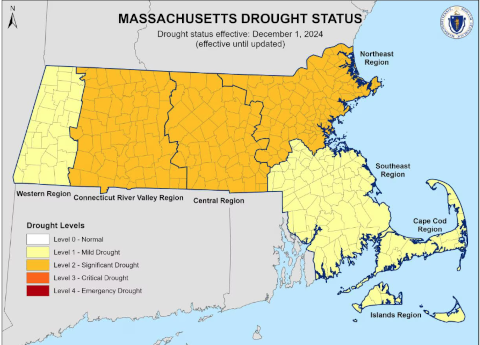
January 8, 2025
Following several weeks of snow and rain, the Executive Office of Energy and Environmental Affairs declared the Central, Northeast and Connecticut River Valley regions will be downgraded from a Level-3 Critical Drought to a Level-2 Significant Drought. The Western and Southeast Regions will also move from a Level-3 Critical Drought to a Level-1 Mild Drought status due to improved conditions. The Cape and Islands regions remain in a Level-1 Mild Drought.
As outlined in the Massachusetts Drought Management Plan, a Level 2-Signifcant Drought and a Level-1 Mild Drought require detailed monitoring of drought conditions, continued coordination among state and federal agencies to communicate the implementation of water use restrictions, engagement with municipalities, including local Boards of Health, providing technical outreach and assistance to water suppliers and affected municipalities.
Despite the recent rain and snowfall, streamflow remains below normal in much of the state, resulting in dry brooks and streambeds, increased ponding in streams, exposed beaches and sediments, limited fish passage, and drying ponds. However, groundwater levels have improved in all regions. Residents can report dry environmental conditions they are experiencing and submit photos to support state drought monitoring efforts here.
The Drought Management Task Force will meet again on Thursday, February 6, 2025 at 10:00 AM and will update recommendations as necessary. For further information on water conservation and what residents can do, visit the EEA’s drought and water conservation pages.
Below are recommendations for communities and individuals living and working within Level 2 – Significant Drought and Level 1 – Mild Drought Regions
For Region in Level 2 - Significant Drought
Per State regulations ALL NONESSENTIAL OUTDOOR WATER USES ARE BANNED.
Additionally the State has issued the following recommendations for Residents and Businesses:
- Minimize overall water use
- Follow local water use restrictions
- Fix any toilet or faucet leaks immediately
- Aggressively reduce indoor water use by taking shorter showers, running dishwashers and washing machines only on a full load
WATER MANAGEMENT ACT (WMA) REVISIONS – Effective January 20, 2023
Nonessential Outdoor Water Use - State Drought Level Water Restrictions
Per Massachusetts 310 CMR 36.07 (2) (c)
Restrictions on Nonessential Outdoor Water Use as follows:
l. For withdrawals not described in 310 CMR 36.07(2)©2 or 3., as soon as possible but no later than 24 months an issuance of the registration statement, the registrant shall establish enforceable restrictions limiting nonessential outdoor water use, Such restrictions shall be in place during a drought declaration by the Secretary for the drought region, county or watershed where the registrant's withdrawals are located, and nonessential outdoor water use shall be restricted as follows:
- Level I (Mild All nonessential outdoor water uses restricted to no more than one day per week, before 9:00 A.M. and after 5:00 P.M., except that watering of ornamentals and flower gardens with drip irrigation, hand-held hose or watering cans may be permitted.
- Level 2 (Significant Drought), All nonessential outdoor water uses banned, except that watering of ornamentals and flower gardens with drip irrigation, hand-held hose or watering cans may be permitted,
- Level 3 (Critical Drought) or Level 4 (Drought Emergency). All nonessential outdoor water uses are banned.
2. For withdrawals for the maintenance of golf course greens, tees, fairways, and roughs during a drought declaration by the Secretary for the drought region, county or watershed where the registration withdrawals are located. registrants shall comply with the following restrictions on nonessential outdoor water use:
- Level 1 (Mild Drought). Irrigation of fairways shall be reduced to 80% normal, irrigation of roughs shall be reduced to 50% of normal, and there shall be no irrigation of landscaping and ornamentals,
- Level 2 (Significant Drought). Irrigation of fairways shall be reduced to 60% normal, and there shall be no irrigation of roughs, landscaping and ornamentals.
- Level 3 (Critical Drought) or Level 4 (Drought Emergency). Irrigation of fairways shall be reduced to 40% of normal, and there shall be no irrigation of roughs, landscaping and ornamentals.
The Water Management Program regulations, effective January 20, 2023, define nonessential outdoor water use as every use that is not required for essential purposes (310 CMR 36.02).
NONESSENTIAL OUTDOOR WATER USE RESTRICTIONS
The following is a list of outdoor water uses identified in the regulations that will not be restricted under the new conditions in the Massachusetts Water Management Act
(a) health or safety - includes outdoor uses like fire-fighting and municipal pipe flushing to prevent contaminants in water supply pipes, as well as
• public facilities used for cooling such as splash pads and swimming pools
• for washing of boats, engines, or marine equipment to prevent negative saltwater impacts or the transfer of invasive aquatic species
(b) by permit, license, statute or regulation;
(c) for the production of food, including vegetable gardens, and fiber
(d) for maintenance of livestock;
(e) to meet the core functions (those functions essential to the commercial operations) of a business,
(f) for irrigation of public parks before 9:00 a.m. and after 5:00 p.m.,
(g) for irrigation of public and private recreation fields, including those operated by schools, colleges, universities and athletic associations, before 9:00 a.m. and after 5:00 p.m.,
(h) for irrigation of publicly funded shade trees and trees in the public right-of-way;
(i) to establish a new lawn as necessary to stabilize soil in response to new construction or following the repair or replacement of a Title 5 system.
(For a more detailed description of non-restricted essential water uses refer to the, Mass DEP Guidance on Nonessential Outdoor Water Use document included below.
Golf courses are considered exempt and allowed to water as necessary to maintain greens and tees, and limited fairway watering per 310 CMR 36.07(2)(c)2.a. through c.; as summarized in the Mass DEP figure 1 below;
Figure 1 – Mass DEP Golf Course Watering Restrictions
As of January 20, 2023 MassDEP revised sections of its Water Management Act Regulations, 310 CMR 36.00. In Cambridge, this now means that a new condition has been imposed that requires the City to restrict "nonessential outdoor water use" during times of drought declared by the Secretary of Energy and Environmental Affairs.
All nonessential water use restrictions are discussed in section 36.07 Registration Conditions and depend on the level of drought declared.
For more information about the state Water Management Act, Water Resources Management Program, and Regulations, see below links
https://malegislature.gov/Laws/GeneralLaws/PartI/TitleII/Chapter21G
https://www.mass.gov/water-management-act-program
https://www.mass.gov/regulations/310-CMR-3600-massachusetts-water-resources-management-program
Additional Drought Related Resources
https://www.mass.gov/service-details/current-drought-status
https://www.drought.gov/drought/states/massachusetts
December 6, 2024
Current Drought Status for Cambridge = Level 3 Critical Drought - All Nonessential Outdoor Water Uses are Banned
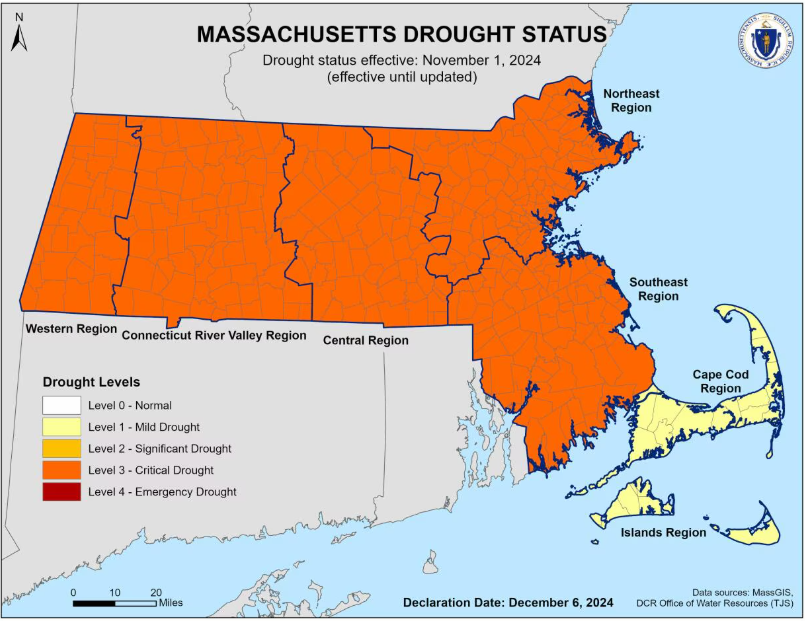
With precipitation at an unprecedented low over the last four months, Energy and Environmental Affairs (EEA) Secretary Rebecca Tepper today raised the Cape Cod and Islands regions to a Level 1-Mild Drought. A Level 3-Critical Drought declaration remains in the Western, Connecticut River Valley, Southeast, Central and Northeast regions. As outlined in the Massachusetts Drought Management Plan, a Level 3-Critical Drought and a Level-1 Mild Drought requires detailed monitoring of drought conditions, continued coordination among state and federal agencies to communicate the implementation of water use restrictions, engagement with municipalities including local Boards of Health, and providing technical outreach assistance to water suppliers and affected municipalities. The Drought Management Task Force will meet monthly to ensure responsive oversight of the drought.
Over the past month, most of the state received between 2 to 4 inches of rain, which is 1.5 to 3.5 inches below normal. The Cape and Islands saw the biggest drop. In recent months, many areas recorded their lowest rainfall ever for this time of the year. Since August, when dry conditions began, the Western, Connecticut River Valley, Southeast, Central and Northeast regions have seen an 8 to 11 inch rainfall deficit while the Cape and Islands are seeing a 3 to 5 inch deficit.
Although the recent rains have helped, streamflow continues to be extremely low across most of the regions. This has resulted in dry brooks and streambeds, increased ponding in streams, exposed beaches and sediments, limited fish passage, and drying ponds. Furthermore, groundwater levels continue to fall in all regions, with the Western, Connecticut River Valley, Central, and Northeast regions showing the largest drops. The recent precipitation has decreased the immediate risk of wildfires. However, as dry conditions persist, we encourage everyone to exercise caution, follow local fire restrictions, ensure all fires are properly extinguished, and remember even a small spark can ignite a fire. Residents can report dry environmental conditions they are experiencing and submit photos to support state drought monitoring efforts here.
The Drought Management Task Force will meet next month and will update recommendations, as necessary.
Below are recommendations for communities and individuals living and working within Level 3 – Critical Drought and Level 2 – Significant Drought Regions, including those utilizing a private well. Residents and businesses are also asked to check with their local water system in case more stringent watering restrictions are in place:
For Region in Level 3 - Critical Drought
Per State regulations ALL NONESSENTIAL OUTDOOR WATER USES ARE BANNED.
Additionally the State has issued the following recommendations for Residents and Businesses:
- Minimize overall water use
- Follow local water use restrictions
- Fix any toilet or faucet leaks immediately
- Aggressively reduce indoor water use by taking shorter showers, running dishwashers and washing machines only on a full load
WATER MANAGEMENT ACT (WMA) REVISIONS – Effective January 20, 2023
Nonessential Outdoor Water Use - State Drought Level Water Restrictions
Per Massachusetts 310 CMR 36.07 (2) (c)
Restrictions on Nonessential Outdoor Water Use as follows:
l. For withdrawals not described in 310 CMR 36.07(2)©2 or 3., as soon as possible but no later than 24 months aner issuance of the registration statement, the registrant shall establish enforceable restrictions limiting nonessential outdoor water use, Such restrictions shall be in place during a drought declaration by the Secretary for the drought region, county or watershed where the registrant's withdrawals are located, and nonessential outdoor water use shall be restricted as follows:
- Level I (Mild All nonessential outdoor water uses restricted to no more than one day per week, before 9:00 A.M. and after 5:00 P.M., except that watering of ornamentals and flower gardens with drip irrigation, hand-held hose or watering cans may be permitted.
- Level 2 (Significant Drought), All nonessential outdoor water uses banned, except that watering of ornamentals and flower gardens with drip irrigation, hand-held hose or watering cans may be permitted,
- Level 3 (Critical Drought) or Level 4 (Drought Emergency). All nonessential outdoor water uses are banned.
2. For withdrawals for the maintenance of golf course greens, tees, fairways, and roughs during a drought declaration by the Secretary for the drought region, county or watershed where the registration withdrawals are located. registrants shall comply with the following restrictions on nonessential outdoor water use:
- Level 1 (Mild Drought). Irrigation of fairways shall be reduced to 80% normal, irrigation of roughs shall be reduced to 50% of normal, and there shall be no irrigation of landscaping and ornamentals,
- Level 2 (Significant Drought). Irrigation of fairways shall be reduced to 60% normal, and there shall be no irrigation of roughs, landscaping and ornamentals.
- Level 3 (Critical Drought) or Level 4 (Drought Emergency). Irrigation of fairways shall be reduced to 40% of normal, and there shall be no irrigation of roughs, landscaping and ornamentals.
The Water Management Program regulations, effective January 20, 2023, define nonessential outdoor water use as every use that is not required for essential purposes (310 CMR 36.02).
NONESSENTIAL OUTDOOR WATER USE RESTRICTIONS
The following is a list of outdoor water uses identified in the regulations that will not be restricted under the new conditions in the Massachusetts Water Management Act
(a) health or safety - includes outdoor uses like fire-fighting and municipal pipe flushing to prevent contaminants in water supply pipes, as well as
• public facilities used for cooling such as splash pads and swimming pools
• for washing of boats, engines, or marine equipment to prevent negative saltwater impacts or the transfer of invasive aquatic species
(b) by permit, license, statute or regulation;
(c) for the production of food, including vegetable gardens, and fiber
(d) for maintenance of livestock;
(e) to meet the core functions (those functions essential to the commercial operations) of a business,
(f) for irrigation of public parks before 9:00 a.m. and after 5:00 p.m.,
(g) for irrigation of public and private recreation fields, including those operated by schools, colleges, universities and athletic associations, before 9:00 a.m. and after 5:00 p.m.,
(h) for irrigation of publicly funded shade trees and trees in the public right-of-way;
(i) to establish a new lawn as necessary to stabilize soil in response to new construction or following the repair or replacement of a Title 5 system.
(For a more detailed description of non-restricted essential water uses refer to the, Mass DEP Guidance on Nonessential Outdoor Water Use document included below.
Golf courses are considered exempt and allowed to water as necessary to maintain greens and tees, and limited fairway watering per 310 CMR 36.07(2)(c)2.a. through c.; as summarized in the Mass DEP figure 1 below;
Figure 1 – Mass DEP Golf Course Watering Restrictions
As of January 20, 2023 MassDEP revised sections of its Water Management Act Regulations, 310 CMR 36.00. In Cambridge, this now means that a new condition has been imposed that requires the City to restrict "nonessential outdoor water use" during times of drought declared by the Secretary of Energy and Environmental Affairs.
All nonessential water use restrictions are discussed in section 36.07 Registration Conditions and depend on the level of drought declared.
For more information about the state Water Management Act, Water Resources Management Program, and Regulations, see below links
https://malegislature.gov/Laws/GeneralLaws/PartI/TitleII/Chapter21G
https://www.mass.gov/water-management-act-program
https://www.mass.gov/regulations/310-CMR-3600-massachusetts-water-resources-management-program
November 19, 2024
Current Drought Status for Cambridge = Level 3 Critical Drought - All Nonessential Outdoor Water Uses are Banned
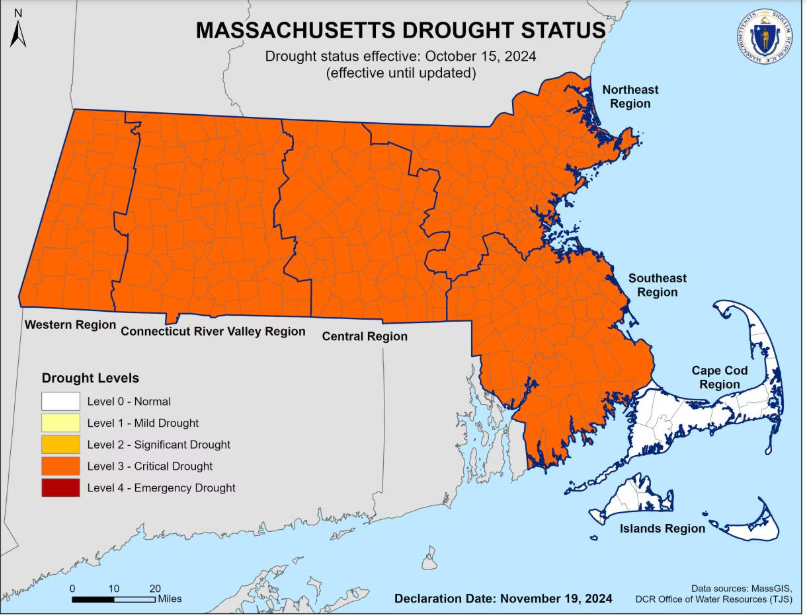
With precipitation at an unprecedented low over the last three months, Energy and Environmental Affairs (EEA) Secretary Rebecca Tepper today elevated the Western, Connecticut River Valley, and Southeast regions to a Level 3 - Critical Drought. A Level 3 - Critical Drought persists in the Central and Northeast regions. The Cape and Islands regions remain at a Level 0 - Normal condition. As outlined in the Massachusetts Drought Management Plan, a Level 3 Critical Drought requires detailed monitoring of drought conditions, close and regular coordination among state and federal agencies, and technical outreach and assistance to the affected municipalities. The Drought Management Task Force will meet biweekly in the coming months to ensure responsive oversight of the drought.
Over the past 30 days, most of the state received less than an inch of rain, which is 3 to 4.5 inches below normal. Many areas recorded their lowest rainfall ever for this time of the year. Since August, when dry conditions began, all regions except the Cape and the Islands have seen an 8 to 11 inch rainfall deficit. Streamflow has also sharply decreased, especially in the Central region. This has resulted in dry brooks and streambeds, increased ponding, exposed beaches and sediments, limited fish passage, and drying ponds. Furthermore, groundwater levels are falling quickly in all regions, with the Western, Connecticut River Valley, Central, and Northeast regions showing the biggest drops.
Dry conditions have also led to an increase in wildfire occurrence and intensity, prompting the Department of Conservation and Recreation (DCR) to implement a temporary ban on all open flame and charcoal fires within state park properties. As firefighting efforts demand significant water resources, it's crucial for residents to practice aggressive indoor water conservation to maintain sufficient supply and pressure in public water systems. Everyone is also urged to exercise caution with grills and open flames, ensuring that all fires are properly extinguished.
The Drought Management Task Force will meet biweekly in the coming months to ensure responsive oversight of the drought.
Below are recommendations for communities and individuals living and working within Level 3 – Critical Drought and Level 2 – Significant Drought Regions, including those utilizing a private well. Residents and businesses are also asked to check with their local water system in case more stringent watering restrictions are in place:
For Region in Level 3 - Critical Drought
Per State regulations ALL NONESSENTIAL OUTDOOR WATER USES ARE BANNED.
Additionally the State has issued the following recommendations for Residents and Businesses:
- Minimize overall water use
- Follow local water use restrictions
- Fix any toilet or faucet leaks immediately
- Aggressively reduce indoor water use by taking shorter showers, running dishwashers and washing machines only on a full load
WATER MANAGEMENT ACT (WMA) REVISIONS – Effective January 20, 2023
Nonessential Outdoor Water Use - State Drought Level Water Restrictions
Per Massachusetts 310 CMR 36.07 (2) (c)
Restrictions on Nonessential Outdoor Water Use as follows:
l. For withdrawals not described in 310 CMR 36.07(2)©2 or 3., as soon as possible but no later than 24 months aner issuance of the registration statement, the registrant shall establish enforceable restrictions limiting nonessential outdoor water use, Such restrictions shall be in place during a drought declaration by the Secretary for the drought region, county or watershed where the registrant's withdrawals are located, and nonessential outdoor water use shall be restricted as follows:
- Level I (Mild All nonessential outdoor water uses restricted to no more than one day per week, before 9:00 A.M. and after 5:00 P.M., except that watering of ornamentals and flower gardens with drip irrigation, hand-held hose or watering cans may be permitted.
- Level 2 (Significant Drought), All nonessential outdoor water uses banned, except that watering of ornamentals and flower gardens with drip irrigation, hand-held hose or watering cans may be permitted,
- Level 3 (Critical Drought) or Level 4 (Drought Emergency). All nonessential outdoor water uses are banned.
2. For withdrawals for the maintenance of golf course greens, tees, fairways, and roughs during a drought declaration by the Secretary for the drought region, county or watershed where the registration withdrawals are located. registrants shall comply with the following restrictions on nonessential outdoor water use:
- Level 1 (Mild Drought). Irrigation of fairways shall be reduced to 80% normal, irrigation of roughs shall be reduced to 50% of normal, and there shall be no irrigation of landscaping and ornamentals,
- Level 2 (Significant Drought). Irrigation of fairways shall be reduced to 60% normal, and there shall be no irrigation of roughs, landscaping and ornamentals.
- Level 3 (Critical Drought) or Level 4 (Drought Emergency). Irrigation of fairways shall be reduced to 40% of normal, and there shall be no irrigation of roughs, landscaping and ornamentals.
The Water Management Program regulations, effective January 20, 2023, define nonessential outdoor water use as every use that is not required for essential purposes (310 CMR 36.02).
NONESSENTIAL OUTDOOR WATER USE RESTRICTIONS
The following is a list of outdoor water uses identified in the regulations that will not be restricted under the new conditions in the Massachusetts Water Management Act
(a) health or safety - includes outdoor uses like fire-fighting and municipal pipe flushing to prevent contaminants in water supply pipes, as well as
• public facilities used for cooling such as splash pads and swimming pools
• for washing of boats, engines, or marine equipment to prevent negative saltwater impacts or the transfer of invasive aquatic species
(b) by permit, license, statute or regulation;
(c) for the production of food, including vegetable gardens, and fiber
(d) for maintenance of livestock;
(e) to meet the core functions (those functions essential to the commercial operations) of a business,
(f) for irrigation of public parks before 9:00 a.m. and after 5:00 p.m.,
(g) for irrigation of public and private recreation fields, including those operated by schools, colleges, universities and athletic associations, before 9:00 a.m. and after 5:00 p.m.,
(h) for irrigation of publicly funded shade trees and trees in the public right-of-way;
(i) to establish a new lawn as necessary to stabilize soil in response to new construction or following the repair or replacement of a Title 5 system.
(For a more detailed description of non-restricted essential water uses refer to the, Mass DEP Guidance on Nonessential Outdoor Water Use document included below.
Golf courses are considered exempt and allowed to water as necessary to maintain greens and tees, and limited fairway watering per 310 CMR 36.07(2)(c)2.a. through c.; as summarized in the Mass DEP figure 1 below;
Figure 1 – Mass DEP Golf Course Watering Restrictions
As of January 20, 2023 MassDEP revised sections of its Water Management Act Regulations, 310 CMR 36.00. In Cambridge, this now means that a new condition has been imposed that requires the City to restrict "nonessential outdoor water use" during times of drought declared by the Secretary of Energy and Environmental Affairs.
All nonessential water use restrictions are discussed in section 36.07 Registration Conditions and depend on the level of drought declared.
For more information about the state Water Management Act, Water Resources Management Program, and Regulations, see below links
https://malegislature.gov/Laws/GeneralLaws/PartI/TitleII/Chapter21G
https://www.mass.gov/water-management-act-program
https://www.mass.gov/regulations/310-CMR-3600-massachusetts-water-resources-management-program
Additional Drought Related Resources
https://www.mass.gov/service-details/current-drought-status
https://www.drought.gov/drought/states/massachusetts
Cambridge Water System - Current Drought Status
October 2024
Current Drought Status for Cambridge = Level 1
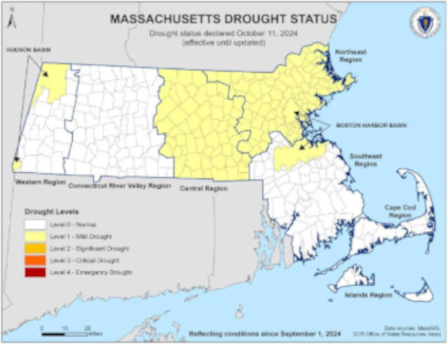
Water Management Act Revisions Summary
As of January 20, 2023 MassDEP revised sections of its Water Management Act Regulations, 310 CMR 36.00. In Cambridge, this now means that a new condition has been imposed that requires the City to restrict "nonessential outdoor water use" during times of drought declared by the Secretary of Energy and Environmental Affairs.
All nonessential water use restrictions are discussed in section 36.07 Registration Conditions and depend on the level of drought declared.
- Level 1 (Mild Drought): All nonessential outdoor water uses restricted to no more than one day per week, before 9 a.m. and after 5 p.m., except that watering of ornamentals and flower gardens with drip irrigation, hand-held hose or watering cans may be permitted.
Updates to section 36.03 Definitions identify the following exempt, essential, Cambridge-specific water uses summarized below (for a full list, follow the previous hyperlink to the current regulations).
- water used for public splash pads and swimming pools, and for certain types of boat washing,
- irrigation of public parks before 9:00 a.m. and after 5:00 p.m.,
- irrigation of public and private recreation fields, including those operated by schools, colleges, universities, and athletic associations, before 9:00 A.M. and after 5:00 P.M.,
- irrigation of publicly-funded shade trees and trees in the public right-of-way
- water used to meet the core functions (those functions essential to the commercial operations) of a business, including but not limited to:
- plant nurseries as necessary to maintain stock;
- golf courses* as necessary to maintain greens and tees, and limited fairway watering;
- venues used for weddings or similar special events that limit watering to hand-held hose or drip irrigation as necessary to maintain gardens, flowers and ornamental plants;
- professional washing of exterior building surfaces, parking lots, driveways and/or sidewalks as necessary to apply surface treatments such as paint, preservatives, stucco, pavement, or cement in the course of construction, reconstruction or renovation work;
- for food and fiber production including vegetable gardens,
- to establish a new lawn as necessary to stabilize soil in response to new construction.
*Restricted golf course uses are discussed in 310 CMR 36.07(2)(c)2 and based on the current declared drought level.
- Level 1 (Mild Drought). Irrigation of fairways shall be reduced to 80% of normal, irrigation of roughs shall be reduced to 50% of normal, and there shall be no irrigation of landscaping and ornamentals.
For more information about the state Water Management Act, Water Resources Management Program, and Regulations, see below links
https://malegislature.gov/Laws/GeneralLaws/PartI/TitleII/Chapter21G
https://www.mass.gov/water-management-act-program
https://www.mass.gov/regulations/310-CMR-3600-massachusetts-water-resources-management-program
Additional Drought Related Resources
https://www.mass.gov/service-details/current-drought-status
https://www.drought.gov/drought/states/massachusetts
August 13, 2024
Energy and Environmental Affairs Secretary Rebecca Tepper declared today that Cambridge remains in Level 0-Normal conditions.
To view the current drought status map, please follow this link: https://www.mass.gov/info-details/drought-status
July 15, 2024
Energy and Environmental Affairs Secretary Rebecca Tepper declared today that Cambridge remains in Level 0-Normal conditions.
To view the current drought status map, please follow this link: https://www.mass.gov/info-details/drought-status
April 11, 2024
Energy and Environmental Affairs Secretary Rebecca Tepper declared today that Cambridge remains in Level 0-Normal conditions.
To view the current drought status map, please follow this link: https://www.mass.gov/info-details/drought-status
March 8, 2024
Energy and Environmental Affairs Secretary Rebecca Tepper declared today that Cambridge remains in Level 0-Normal conditions.
To view the current drought status map, please follow this link: https://www.mass.gov/info-details/drought-status
December 14, 2023
Energy and Environmental Affairs Secretary Rebecca Tepper declared today that Cambridge remains in Level 0-Normal conditions.
To view the current drought status map, please follow this link: https://www.mass.gov/info-details/drought-status
July 14, 2023
Energy and Environmental Affairs Secretary Rebecca Tepper declared today that Cambridge remains in Level 0-Normal conditions.
To view the current drought status map, please follow this link: https://www.mass.gov/info-details/drought-status
June 13, 2023
Energy and Environmental Affairs Secretary Rebecca Tepper declared today that Cambridge remains in Level 0-Normal conditions.
To view the current drought status map, please follow this link: https://www.mass.gov/service-details/current-drought-status
February 14
February 13, 2023: The months of December and January brought above-normal rainfall across all regions of the Commonwealth, helping with the recovery of groundwater, streamflow, lakes, and impoundments. As a result, Cambridge has been returned to a Level 0-Normal Conditions.
January featured above average precipitation, mostly in the form of rain resulting in significant improvement to hydrological conditions. Precipitation totals in the east ranged from as much as 6 to 12 inches.
Even in winter months it continues to be important to save water, which can be achieved by ramping up indoor use considerations. The top three ways to conserve water indoors are to fix leaks, consider water use habits, and change out older fixtures and appliances to save water, energy and money. More details and additional ideas are provided at https://www.mass.gov/guides/indoor-water-conservation. EEA urges residents and businesses to continue to be extremely mindful of their overall water use.
To view the current drought status map, please follow this https://www.mass.gov/service-details/current-drought-status
January 17, 2023:
January 13, 2023: Through the month of December 2022, the majority of the state experienced drought improvements and as a result, Energy and Environmental Affairs (EEA) Secretary Rebecca Tepper today announced that the Cambridge drought has been changed to Level 1-Mild Drought. Rain and snow events during the previous month and a half have been well above normal and conditions are expected to continue to improve through January 2023. However, for the state to be completely out of the drought, which is a longer-term condition, Massachusetts will need to benefit from sustained rainfall for a few more months before the entire state is within Normal conditions.
The significant drought conditions require close coordination among local, state, and federal agencies, with a significant emphasis on water conservation and more stringent watering restrictions.
To view the current drought status map, please follow this https://www.mass.gov/service-details/current-drought-status
January 9, 2023:
As of December 12, 2022: With below normal precipitation in November in some regions of the state and longer-term deficits in most regions, Energy and Environmental Affairs (EEA) Secretary Beth Card today made the following drought declaration that the Northeast has been changed to Level 2 – Significant Drought. It is important to note that while the western portion of the Northeast Region is faring a little better, most of this region has more significant drought impacts from long-term drought conditions. This declaration will remain in effect till the next declaration in January.
The significant drought conditions require close coordination among local, state, and federal agencies, with a significant emphasis on water conservation and more stringent watering restrictions.
Cambridge Water Department strongly recommends practicing the following water conservation tips:
- Stop or minimize all outdoor watering;
- Look and listen to see if you have any water leaking, checking toilets often;
- Never let water run while doing dishes, brushing teeth, or washing hands;
- Flush toilets only when needed.
To view the current drought status map, please follow this https://www.mass.gov/service-details/current-drought-status
November 15, 2022:
As of the November 15, 2022 Energy and Environmental Affairs (EEA) Secretary Bethany Card declared that the Cambridge drought has been changed to Level 1-Mild Drought. This is due to the fact that several recent precipitation events in October that directly benefited Massachusetts’ hydrological systems. This declaration will remain in effect till the next declaration in December.
The significant drought conditions require close coordination among local, state, and federal agencies, with a significant emphasis on water conservation and more stringent watering restrictions.
To view the current drought status map, please follow this https://www.mass.gov/service-details/current-drought-status
October 10, 2022:
As of the October 7, 2022, Energy and Environmental Affairs (EEA) Secretary Bethany Card declared that the Cambridge drought has been changed to Level 2-Signficant Drought. This is due to the fact that several recent precipitation events in September that directly benefited Massachusetts’ hydrological systems. This declaration will remain in effect till the next declaration in November.
The significant drought conditions require close coordination among local, state, and federal agencies, with a significant emphasis on water conservation and more stringent watering restrictions.
Cambridge Water Department strongly recommends practicing the following water conservation tips:
- Stop or minimize all outdoor watering;
- Look and listen to see if you have any water leaking, checking toilets often;
- Never let water run while doing dishes, brushing teeth, or washing hands;
- Flush toilets only when needed.
To view the current drought status map, please follow this https://www.mass.gov/service-details/current-drought-status
September 9, 2022
As of the September 8, 2022, Energy and Environmental Affairs (EEA) Secretary Bethany Card declared that the Cambridge drought level has remained the same, Level 3-Critical Drought. This declaration will remain in effect till the next declaration in Mid-September.
The Water Department will continue to monitor the meetings of the Drought Management Task Force for any changes in Cambridge’s drought status.
The significant drought conditions require close coordination among local, state, and federal agencies, with a significant emphasis on water conservation and more stringent watering restrictions. Cambridge Water Department strongly recommends practicing the following water conservation tips:
- Stop or minimize all outdoor watering;
- Look and listen to see if you have any water leaking, checking toilets often;
- Never let water run while doing dishes, brushing teeth, or washing hands;
- Flush toilets only when needed.
To view the current drought status map, please follow this link: https://www.mass.gov/service-details/current-drought-status
August 26, 2022
As of the August 23, 2022, Energy and Environmental Affairs (EEA) Secretary Bethany Card declared that the Cambridge drought level has remained the same, Level 3-Critical Drought.
The Water Department will continue to monitor the meetings of the Drought Management Task Force for any changes in Cambridge’s drought status.
The significant drought conditions require close coordination among local, state, and federal agencies, with a significant emphasis on water conservation and more stringent watering restrictions. Cambridge Water Department strongly recommends practicing the following water conservation tips:
- Stop or minimize all outdoor watering;
- Look and listen to see if you have any water leaking, checking toilets often;
- Never let water run while doing dishes, brushing teeth, or washing hands;
- Flush toilets only when needed.
To view the current drought status map, please follow this link: https://www.mass.gov/service-details/current-drought-status
August 17, 2022
As of the August 9, 2022, Energy and Environmental Affairs (EEA) Secretary Bethany Card declared that the Cambridge drought level has remained the same, Level 3-Critical Drought.
The Water Department will continue to monitor the meetings of the Drought Management Task Force for any changes in Cambridge’s drought status.
The significant drought conditions require close coordination among local, state, and federal agencies, with a significant emphasis on water conservation and more stringent watering restrictions. Cambridge Water Department strongly recommends practicing the following water conservation tips:
- Stop or minimize all outdoor watering;
- Look and listen to see if you have any water leaking, checking toilets often;
- Never let water run while doing dishes, brushing teeth, or washing hands;
- Flush toilets only when needed.
To view the current drought status map, please follow this link: https://www.mass.gov/service-details/current-drought-status
July 25, 2022
As of the July 21, 2022, Energy and Environmental Affairs (EEA) Secretary Bethany Card declared that the Cambridge drought level has changed to a Level 3-Critical Drought.
The Water Department will continue to monitor the meetings of the Drought Management Task Force for any changes in Cambridge’s drought status.
The significant drought conditions require close coordination among local, state, and federal agencies, with a significant emphasis on water conservation and more stringent watering restrictions. Cambridge Water Department strongly recommends practicing the following water conservation tips:
- Stop or minimize all outdoor watering;
- Look and listen to see if you have any water leaking, checking toilets often;
- Never let water run while doing dishes, brushing teeth, or washing hands;
- Flush toilets only when needed.
To view the current drought status map, please follow this link: https://www.mass.gov/service-details/current-drought-status
July 13, 2022
As of the July 12, 2022, Energy and Environmental Affairs (EEA) Secretary Bethany Card announced that the Cambridge drought level remains at a Level 2-Signficant Drought.
The Water Department will continue to monitor the meetings of the Drought Management Task Force for any changes in Cambridge’s drought status.
Although the drought level is Normal Condition in our region of the State, the Cambridge Water Department strongly recommends practicing the following water conservation tips:
• Stop or minimize all outdoor watering;
• Look and listen to see if you have any water leaking, checking toilets often;
• Never let water run while doing dishes, brushing teeth, or washing hands;
• Flush toilets only when needed.
To view the current drought status map, please follow this link: https://www.mass.gov/info-details/drought-status
June 2022
On June 15, 2022, Secretary of Energy and Environmental Affairs Bethany Card declared a Level 2-Signficant Drought in the Northeast of the Commonwealth. The significant drought conditions require close coordination among local, state, and federal agencies, with a significant emphasis on water conservation and more stringent watering restrictions.
Cambridge Water Department strongly recommends practicing the following water conservation tips:
- Stop or minimize all outdoor watering;
- Look and listen to see if you have any water leaking, checking toilets often;
- Never let water run while doing dishes, brushing teeth, or washing hands;
- Flush toilets only when needed.
To view the current drought status map, please follow this https://www.mass.gov/service-details/current-drought-status
May 2022
As of the May 11th meeting of the Drought Management Task Force, the Cambridge drought level remains at a Level 0 – Normal Condition.
The Water Department will continue to monitor the meetings of the Drought Management Task Force for any changes in Cambridge’s drought status.
Although the drought level is Normal Condition in our region of the State, the Cambridge Water Department strongly recommends practicing the following water conservation tips:
• Stop or minimize all outdoor watering;
• Look and listen to see if you have any water leaking, checking toilets often;
• Never let water run while doing dishes, brushing teeth, or washing hands;
• Flush toilets only when needed.
To view the current drought status map, please follow this link: https://www.mass.gov/info-details/drought-status
July 2021
The Cambridge drought level remains at a Level 0 – Normal Condition.
The Water Department will continue to monitor the meetings of the Drought Management Task Force for any changes in Cambridge’s drought status.
Although the drought level is Normal Condition in our region of the State, the Cambridge Water Department strongly recommends practicing the following water conservation tips:
• Stop or minimize all outdoor watering;
• Look and listen to see if you have any water leaking, checking toilets often;
• Never let water run while doing dishes, brushing teeth, or washing hands;
• Flush toilets only when needed.
May 2021
The Cambridge drought level has returned to Level 0 – Normal Condition
Following normal or above normal rainfall, leading to the recovery of all indices, Energy and Environmental Affairs Secretary Kathleen Theoharides has declared a Level 0 – Normal Conditions in the Northeast (Cambridge) and Southeast Regions of the Commonwealth while the rest of the State remain in a Level 1 – Mild Drought Condition. The declaration is the result of a recommendation issued from a recent meeting of the Drought Management Task Force, comprised of state and federal officials, and other entities.
April 2021
The Cambridge drought level has returned to Level 1-Mild Drought.
With precipitation, streamflow, and groundwater below normal as the state enters the spring season, Energy and Environmental Affairs (EEA) Secretary Kathleen Theoharides declared a Level 1-Mild Drought in the Western, CT River Valley, Central, Northeast, and Cape Cod Regions. In January 2021, the Cambridge drought level had been returned Level 0 – Normal Condition. The declarations were the result of a recommendation issued from a recent meeting of the Drought Management Task Force, comprised of state and federal officials, and other entities.
February 10, 2021
The Cambridge drought level has returned Level 0 – Normal Condition
Following almost three months of normal or above normal rainfall, leading to the recovery of all indices, Energy and Environmental Affairs Secretary Kathleen Theoharides today declared an end to the drought in the Commonwealth and a Level 0 – Normal Condition in all seven regions of the state - Western, Connecticut River Valley, Central, Northeast, Southeast, Cape Cod and Islands regions. All seven regions were experiencing Level 1-Mild Drought conditions last month. The declarations were the result of a recommendation issued from a recent meeting of the Drought Management Task Force, comprised of state and federal officials, and other entities.
December 7, 2020
The Cambridge drought level continues to be Level 1 - mild drought level.
Following increased amounts of rainfall through the month of November, Energy and Environmental Affairs (EEA) Secretary Kathleen Theoharides today declared that drought conditions continue to improve or hold steady across the Commonwealth, with all seven regions of the state currently in a Level 1-Mild Drought. In the Southeast and Cape Cod Regions, conditions moved to a Level 1-Mild Drought after experiencing Level 2-Significant Drought conditions last month. In the Western, Connecticut River Valley, Central, Northeastern, and Islands regions, conditions remained at a Level 1-Mild Drought, unchanged from last month’s declaration. Additionally, conditions improved in the Nashua River basin, which is now experiencing Level 1-Mild Drought conditions in line with the Central Region. A Level 1-Mild Drought, as outlined in the Massachusetts Drought Management Plan, warrants detailed monitoring of drought conditions, close coordination among state and federal agencies, and technical outreach and assistance for the affected municipalities.
The drought was originally declared during the summer and continued to worsen. The significant drought conditions require close coordination among local, state, and federal agencies, with a significant emphasis on water conservation and more stringent watering restrictions. Although the drought level remains the same, Cambridge Water Department strongly recommends practicing the following water conservation tips:
• Stop or minimize all outdoor watering;
• Look and listen to see if you have any water leaking, checking toilets often;
• Never let water run while doing dishes, brushing teeth, or washing hands;
• Flush toilets only when needed.
To View the December drought update from the Executive Office of Energy and Environmental Affairs, please click this link
November 9, 2020
Cambridge drought level has been reduced to a Level 1 – Mild Drought from a Level 3 – Critical Drought.
Following relatively higher amounts of rainfall in the final weeks of October, Energy and Environmental Affairs (EEA) Secretary Kathleen Theoharides today declared that drought conditions have improved in most regions of the Commonwealth. In the Western, Connecticut River Valley, Central, Northeastern, and Islands regions, conditions improved to a Level 1-Mild Drought. In the Southeast Region, conditions moved to a Level 2-Signficiant Drought after experiencing Level 3-Critical Drought conditions last month. The Cape Cod Region remains at a Level 2-Significant Drought, unchanged from last month’s declaration. Additionally, conditions improved in the Charles and Millers River basins, which are now in a Level 1-Mild Drought in line with their regions after experiencing Level 3-Critical Drought conditions last month. Responding to worsening conditions in the Nashua River basin, Secretary Theoharides declared a Level 2-Significant Drought in the watershed.
October 9, 2020
Due to five months of below average rainfall the Energy and Environmental Affairs (EEA) Secretary has declared a Level 3 – Critical Drought in the Southeast Region as well as the Charles and Millers River basins of Massachusetts. The remainder of the state remains in a Level 2 Severe Drought condition. The drought was originally declared during the summer and has continued to worsen. The significant drought conditions require close coordination among local, state, and federal agencies, with a significant emphasis on water conservation and more stringent watering restrictions. Cambridge Water Department strongly recommends practicing the following water conservation tips:
- Stop or minimize all outdoor watering;
- Look and listen to see if you have any water leaking, checking toilets often;
- Never let water run while doing dishes, brushing teeth, or washing hands;
- Flush toilets only when needed.
To view the current drought status map, please follow this link: https://www.mass.gov/service-details/current-drought-status
September 5, 2020
On September 4, 2020 – the Level 2 drought level remains unchanged from the previous month’s declaration.
A copy of the formal drought declaration letter can be seen using the following link:
Drought Declaration Letter
As of August 12, 2020 the Drought Management Task Force has recommended and the Secretary of Energy and Environmental Affairs has declared a level 2 – Significant Drought.
Early Summer 2020, the Massachusetts Department of Environmental Protection (MADEP) has declared that Middlesex County and other locations in Massachusetts be categorized as being in at Level 1 a Mild Drought which is based on the updated State Drought Management plan put into use in September of 2019.
Drought Management Task Force Presentation
Additional Drought Related Resources
https://www.mass.gov/service-details/current-drought-status
https://www.drought.gov/drought/states/massachusetts