Demolition Review
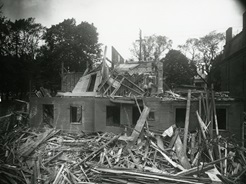
Update: On Nov. 18, 2019 the City Council voted to approve extending the demolition delay period from six months to twelve months.
Application Forms
WHAT IS THE DEMOLITION REVIEW ORDINANCE FOR THE CITY OF CAMBRIDGE?
The Demolition Review Ordinance (Chapter 2.78, Article II of the Cambridge Municipal Code) was adopted by the City Council in 1979 to afford public review of demolition permit applications for potentially significant buildings. When the Historical Commission determines that a building is significant and should be preserved, demolition will be delayed for up to twelve months so that solutions can be sought to preserve the building indefinitely. The Ordinance covers all buildings over 50 years old, city-wide. The Historical Commission archives provide dates of construction for all properties in the City.
Demolition is defined in the Demolition Review Ordinance as "the act of pulling down, destroying, removing or razing a building or commencing the work of total or substantial destruction with the intent of completing the same." Demolition permits are issued by the Inspectional Services Department (ISD). See the ISD permit portal for more guidance on what work requires a demolition permit.
WHAT IS THE HISTORICAL COMMISSION PROCESS FOR REVIEW OF DEMOLITION? Email the CHC Executive Director for an initial determination of significance of a particular property. If the Executive Director of the Historical Commission makes an initial determination that the building is significant, a public hearing will be scheduled with Historical Commission. Posting of a placard on the site is required for cases requiring a public hearing.. If the Executive Director makes an initial determination that the building is not significant, you may apply directly for the permit in the ISD permit portal. Applications to demolish utilitarian structures, such as some residential garages, do not generally require a public hearing, however, they do require a review and sign-off from the Historical Commission staff.
When a demolition application is reviewed at a public hearing, the Historical Commission votes on two issues: first, whether to confirm the staff finding that the building is significant, and second, whether it is in the public interest that the building be preserved. During this part of the hearing, the applicant will present the plans for the proposed replacement structure. If the Commission finds that a building is significant and preferably preserved, it cannot be demolished for twelve months from the date of the hearing. In some cases, further action may be taken to permanently protect a significant and "preferably preserved" building or structure through landmark designation or donation of a preservation easement.
WHAT ARE THE CRITERIA FOR DETERMINING A BUILDING'S SIGNIFICANCE?
A "significant building" is one that, according to the City Code, is at least 50 years old and is listed on the National Register of Historic Places, or is a designated landmark, or is in a historic district, or is determined to be "importantly associated with one or more historic persons or events, or with the broad architectural, cultural, political, economic or social history of the City or the Commonwealth, or . . . historically or architecturally significant (in terms of period, style, method of building construction or association with a famous architect or builder) either by itself or in the context of a group of buildings." Email the CHC Executive Director for an initial determination of significance of a particular property.
A determination that a significant building is "preferably preserved" (relative to the proposed replacement structure) is made if the Commission finds that it is in the public interest that the building should be preserved.
WHAT HAPPENS TO A PREFERABLY PRESERVED SIGNIFICANT BUILDING AFTER THE TWELVE-MONTH DELAY EXPIRES?
The Commission can initiate a landmark designation study and has passed a policy to consider this action on the eleventh month of a demolition delay for all preferably preserved significant buildings. See policy for details. If no action has been taken to designate the building as a landmark and no one is willing to preserve it, then the building can be demolished and the proposed development can proceed, provided that all plans for the use of the site after demolition have been found to comply with applicable laws and all permits and approvals for the development have been obtained. The intent of the delay period is not always to prevent demolition but to provide an opportunity for the development of preservation solutions to be considered.
All of the Commission's regulatory approvals have a life of six months. This means that once the above conditions have been satisfied, the owner of the property has six months to demolish the building. If the building is not taken down in that period, the Chair of the Commission may issue a six-month extension. If an extension is not issued, the owner must resubmit the demolition permit application for Commission review.