The prevalence rates of domestic and gender-based violence are staggering. They are issues that impact all of us and also issues that many people struggle to understand. The DGBVPI works to raise public awareness and understanding through trainings, social media campaigns, visual displays, workshops, etc. The Initiative also works with various organizations to create prevention strategies that are appropriate for their needs, setting, and population.
Trainings
The Initiative offers a wide variety of trainings. Our domestic and sexual violence 101 training is offered a few times a year for providers and community members. Additionally, the Initiative partners with organizations to create trainings/workshops tailored to the needs of that organization in regards to domestic and gender based violence.
In the past year the Initiative has conducted trainings with: Mt. Auburn Hospital, My Brother’s Keeper, Hildebrand, and across various city departments.
Social Media Campaigns
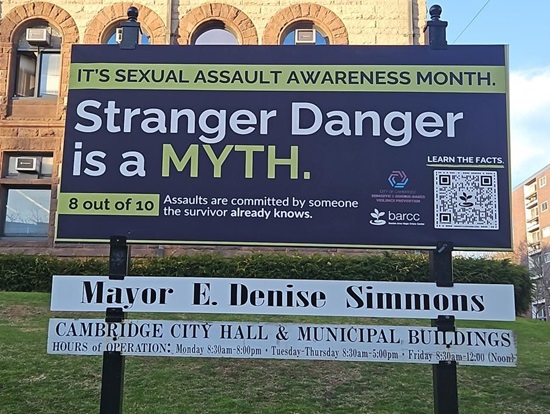
The Initiative partners with local organizations and City Departments to conduct social media campaigns sharing relevant facts and information about DGBV with the community.
Confronting the Weaponization of Sexual Violence Against Black and Immigrant Communities
February 2026
Trigger Warning This statement includes descriptions of sexual violence, racial terror, and state violence. Please care for yourself as you engage.
During Black History Month, and on the 100th anniversary of Negro History Week, we confront a painful and persistent truth: sexual violence has long been weaponized to justify violence, surveillance, and punishment against Black, Immigrant, and Indigenous communities.
Since the colonization of this land, carried out through the violent dispossession, forced removal, and attempted erasure of Indigenous peoples, sexual violence has been used as a tool of domination, control, and racial hierarchy in what would become the United States. The founding of the British colonies and later the U.S. was built not only through land theft and genocide, but through gendered and sexual violence that sought to break families, strip sovereignty, and normalize the dehumanization of entire peoples.
From the outset, sexual violence was woven into systems of conquest, enslavement, and settler expansion- and has repeatedly been used to justify further violence against Indigenous, Black Immigrant, and other marginalized communities. These communities have been the most harmed by sexual violence and have been the least believed, the least protected, and the least visible in our public narratives. This is not only our history. It is happening now.
Today, our immigrant neighbors, particularly those racialized as Black and Brown, are being brutalized in their homes, in their workplaces, places of learning, and in public spaces. At the same moment, survivors of sexual violence, harmed when they were children and/or adults, continue to fight for accountability and healing in systems that too often dismiss or minimize their experiences. Racism, xenophobia, and sexual violence become mutually reinforcing systems of harm in the United States. Each feeds the other: racist narratives justify violence; fear-based politics distort the reality of sexual harm, who is seen as a harm doer and who isn't; and survivors, especially those from marginalized communities, are left without the care and protection they deserve.
As advocates, public servants, and leaders in the anti-violence movement, it is our responsibility to name these connections clearly and challenge them directly.
We, the Boston Public Health Commission’s Domestic, Sexual, and Gender-Based Violence Prevention Initiative (DSG), the City of Cambridge’s Domestic and Gender-Based Violence Prevention Initiative (DGBVPI), and the Boston Area Rape Crisis Center (BARCC), issue this joint statement during Black History Month to confront a painful and persistent truth: sexual violence has long been weaponized to justify violence, surveillance, and retribution; especially against Black, Indigenous, and Immigrant communities.
What do we mean by this?
From lynching-era myths that portrayed Black men as sexual predators, to contemporary rhetoric that labels Black and Brown immigrants as “rapists,” “abusers,” and “criminals;” these narratives have repeatedly been used to incite fear and rationalize both state-sanctioned and interpersonal violence. The intention has never been to protect survivors, but to maintain systems of coercive power.
Journalist and anti-lynching activist Ida B. Wells documented in A Red Record that over ten thousand lynchings of Black people, largely Black men, took place between 1865 and 1895. In many of these cases, rape was invoked as the justification for this racial terror.
As Senator Ben Tillman of South Carolina infamously declared:
“When stern and sad-faced White men put to death a creature in human form who has deflowered a white woman, they have avenged the greatest wrong, the blackest crime…such crimes caused civilized men to revert to the original savage type whose impulses under such circumstances have always been to kill, kill, kill.” (1907)
But this justification was not grounded in truth. It was an excuse, and it was a lie.
Frederick Douglass powerfully challenged this myth in his 1894 pamphlet The Lesson of the Hour, later reprinted as “Why is the Negro Lynched?”
“Throughout the entire Civil War, in fact not a single Black man was publicly accused of raping a white woman. If Black men possessed an animalistic urge to rape, argues Douglass, this alleged rape instinct would have certainly been activated when white women were left unprotected by their men who were fighting in the Confederate Army”.The Life and Writings of Frederick Douglass, Vol. 4, pp. 498-499
The senator’s declaration was not evidence; it was propaganda designed to uphold systems of racism.While Black men were being falsely accused and mercilessly punished, the actual sexual violence perpetrated by white men against Black women was pervasive and systematically ignored. From the holding cells of slave castles, through the Middle Passage, in the cotton fields, in kitchens and pantries, and in private homes where scores of Black women engaged in low-wage domestic work after the Civil War, Black women endured routine sexual abuse with little to no legal recourse.
As scholars have documented, virtually all nineteenth-century slave narratives contain accounts of Black women’s sexual victimization at the hands of masters and overseers. This violence was not aberrational; it was structural.
Black communities felt this harm deeply and resisted it in every way available to them: through organizing, storytelling, collective care, and mutual aid. Yet their outcry was largely dismissed by those in power.
Fast forward to today.
We see the same playbook being used against immigrants in 2026. Public rhetoric labels immigrant communities as “rapists” and “violent criminals,” providing cover for raids, detention, deportation, and civil rights violations. This language does not protect survivors; it criminalizes entire communities, particularly Black,Brown, and Immigrant communities.
"They're bringing drugs, they're bringing crime, they're rapists," Trump said of immigrants, and later claimed that they were, "Savage, illegal alien criminals who have been raping, pillaging, and killing our cities and our towns.” (Bineham, 2025)
Yet the data tells a very different story. From May 2019 to November 2025, U.S. Immigration and Customs Enforcement (ICE) detained 65,735 people and 73.6% of them had no criminal conviction. This gap between rhetoric and reality reveals that the promise of removing “violent criminals and rapists” has often been a political strategy rather than a public safety measure.
This propaganda takes root, not because it is new, but because it is functioning exactly as it was created to function. The same racist and sexist narrative machinery that once justified lynching by portraying Black men as sexual predators, and erasing the harms Black Women faced, now legitimizes mass detention and deportation by portraying immigrants as inherently dangerous; while ignoring actual sexual violence occurring within state run systems. Meanwhile, a report from the office of U.S. Senator Jon Ossoff of Georgia documents serious concerns regarding treatment in Department of Homeland Security (DHS) custody. The report, based on site inspections and key informant interviews conducted in Texas and Georgia between January 2025 and January 2026, found:
“The Senator’s staff received or identified 88 credible reports of individuals experiencing physical and/or sexual abuse while in DHS custody. Detainees reported being beaten by detention facility staff and being placed in solitary confinement after reporting their abuse.” (Ossoff 2026).
These are not isolated incidents; they are symptoms of a system that dehumanizes people; they are durable, racist strategies that continue to determine who is presumed threatening, who is presumed worthy of protection, and whose lives are treated as expendable.
We would be remiss if we did not acknowledge the ongoing impact of the largest known sex trafficking network. Survivors of the sexual violence committed and facilitated by Jeffrey Epstein and his network have been demanding justice for decades.
Although approximately 3.5 million of an estimated 6 million documents have now been made public, this partial disclosure leaves survivors and the public without the full transparency required by law. At the same time, the release has harmed survivors by exposing their identities and, in some cases, circulating sensitive and explicit images and videos while the identities of many powerful individuals who perpetrated or enabled this abuse remain shielded from accountability.
We have been inundated with evidence of the harm survivors endured, yet meaningful justice and systemic accountability remain painfully absent.
This forces us to ask a difficult question: Do we truly care about survivors of sexual violence, or do we care only when their pain can be used to advance a punitive agenda?
Too often, public outrage centers punishment rather than healing. We hear calls for harsher penalties, more policing, more detention and incarceration; but far fewer calls for survivor-centered care, prevention, or investment in community-based services. In fact, funding for many survivor services has been cut drastically at precisely the moment when need is greatest. The Office on Violence Against Women’s proposed budget went from approximately $713 million in Fiscal Year 2025 to $505 million in Fiscal Year 2026. That's a reduction of nearly 30 percent and the reductions include cuts to transitional housing assistance, the sexual assault services program, the rural victims' program.
A different vision of safety:
A society that weaponizes sexual violence against marginalized communities while neglecting actual survivors does not make anyone safer. The experiences of Black, Indigenous, and Immigrant communities reveal where our collective responsibilities lie.
Together, we commit to a different vision of safety: one grounded in truth, care, community, and accountability rather than fear, scapegoating, and punishment.
Despite immense harm, Black people have continually resisted, healed, and built spaces of care and belonging. Resistance has taken many forms: protest, mutual aid, shared meals, storytelling, and collective learning and care.
This week of Black History Month has been shaped by that same spirit. Through readings, community gatherings, and shared reflection, we have been reminded that resistance is not only confrontation; it is also care. It is the simple but powerful act of saying: you belong here, you deserve safety, you deserve dignity, and you deserve love.
We invite our community to carry this learning forward by engaging with:
As sanctuary cities and survivor-centered institutions, we stand with survivors and with communities targeted by racism and xenophobia, recognizing that these struggles are intertwined.
This Black History Month, and everyday, we honor both the harm and the hope, the resistance and the resilience of survivors and our communities.
We invite you to continue to engage as we offer a Week of Learning, Reflection, and Action from February 23–27.
Guided by the question “Safety for whom? Who is defined as a survivor?”. Each day will feature learning materials, reflection prompts, and community opportunities that center Black leadership, survivor voices, and collective care.
We invite all who care about healing, equity, and true public safety to learn alongside us.
Monday, February 23rd
Roxbury Reads Revolution: Freedom is a Constant Struggle
The year 2026 marks 250 years since the start of the American Revolution. To mark this anniversary, throughout the year, the Roxbury Reads Book Club will be reading and discussing books that inspire revolutionary change.
In February, we will be discussing Angela Davis'Freedom Is A Constant Struggle.In this collection of essays, Davis "illuminates the connections between struggles against state violence and oppression throughout history and around the world" challenging readers "to imagine and build the movement for human liberation."
https://bpl.bibliocommons.com/events/6980b59394297d3600a95556
The Historical Contributions of African American Women of Roxbury
Join us for an enlightening and engaging two-part program centered on The Historical Contributions of African American Women of Roxbury, hosted by Hist-oricaly Cor-rect!
From 3-4 p.m., there will be a teens-only gallery walk activity.
Then from 4-5 p.m., there will be an all-ages presentation.
Tuesday, February 24 — Learn & Unlearn: “The Cost of Fear: Why Most Safety Advice is Sexist and How We Can Stop Gender-Based Violence”
Focus: How “safety” narratives can harm survivors and communities.
Learning Material
The Cost of Fear: Why Most Safety Advice is Sexist and How We Can Stop Gender-Based Violence by Meg Stone
Guiding Questions for Reflection
- Who is presumed dangerous?
- Who is presumed deserving of protection?
- Do our current policies center the needs of survivors?
- Does the mainstream narrative promote safety for all or for some?
- Does the mainstream narrative promote healing for survivors?
- Are survivor voices at the center of the conversation?
Call to Action
Read or listen to excerpts from The Cost of Fear or other books that explore sexual violence.
Visit a local bookstore to purchase or borrow these books from your local library.
Additional Recommendations:
“Arrested Justice: Black Women, Violence, and America’s Prison Nation” by Beth Richie
“Missoula” by Jon Krakauer
“Queering Sexual Violence: Radical Voices from within the Antiviolence Movement” by Jennifer Patterson
Check out their website: https://queeringsexualviolence.com/
Opportunity for Self-Care and Community Engagement
The Sanyika Model & Talent Management and The Esther Christine Performing Arts Institute, in partnership with the Shaw-Roxbury Branch Library, present Did You Know...?-- a multifaceted, workshop series focused on self-improvement.
In this month's workshop, a representative from the local wellness non-profit On Her Throne, will guide participants through a journaling and vision board creation exercise.
https://bpl.bibliocommons.com/events/698205bad2bbe265eb2be3fc
Self-Care resource: https://barcc.org/get-help/resources/self-care-and-coping-exercises/
Wednesday, February 25 — Honoring Black Women Who Built the Anti-Violence Movement
Focus: Black women’s leadership in resisting sexual and state violence.
Long before federal or state governments created formal domestic or sexual violence response systems, Black women were organizing to protect one another, their families, and their communities from both sexual violence and state violence. Their work was never only about individual harm; it was about collective survival and freedom.
Black women have historically held together multiple truths at once:
- that sexual violence is real and devastating,
- that it has been weaponized to justify racial terror, and
- that the state is often a perpetrator of harm rather than a protector.
Because of this, Black women-led resistance has always been both anti-rape and anti-racist, both pro-survivor and anti-state violence, and both protective and liberatory.
Their leadership shaped what we now understand as the anti-violence movement: community accountability, mutual aid, and safety planning rooted in relationships.
Leaders we honor today
Ida B. Wells
Rosa Parks
Beth Richie PhD
Guiding Question
- How did Black women center both survivor dignity and community safety in their work?
- How did Black women resist the larger narrative that did not include their reality?
Call to Action/Ways to Engage
- Share one quote or lesson from a Black woman leader in the anti-violence movement.
- Donate to a Black-led survivor support organization.
- Watch, “The Rape of Recy Taylor”
- Watch “Black Women, Violence, and Incarceration” feat. Beth Richie, PhD
Thursday, February 26 — Faith, Identity & Safety
Featured Event
Finding Acceptance as LGBTQIA2S+ in the Black Church
City of Boston — 6:00–7:45 pm
Location: 1234 Columbus Ave, Building 3
Boston, MA 02120
Community Gathering
Central Square Cooks Book Group — Jubilee by Toni Tipton-Martin
Cambridge Public Library, Central Square Branch
Reflection Questions
- How can we move past our social indoctrination to dehumanize based on different aspects of someone's identity?
- What does it look like to care for others in a way that honors every part of them?
Friday, February 27 and Saturday February 28 — Community & Care
Focus: Healing and thriving cannot happen in isolation
Today is a good day to deepen connections with others. We encourage you to see people as fully human no matter their identities and engage with them as such.
Supporting Black-owned spaces and mutual aid. Black Boston (list of black/minority owned Boston Businesses) visit the City of Boston’s Black History Month website for more resources
Individual Care: BEAM
BRL88: Prepare & Repair Symposium
The PrydeBoston, MA
Saturday, Feb 28 from 11 am to 1:30 pm
Start your day in peace, reflection, and renewal. The Prepare & Repair Symposium begins with a morning community healing session featuring sound healing, guided meditation, and acupuncture — designed to center the body and spirit before our day of collaboration and dialogue.
Afterward, join the Afrimerican Academy and partners for a powerful gathering of nonprofits, advocates, and community leaders focused on the theme “Collaboration as Restoration.” Together, we’ll explore how unity and cooperative leadership can heal the social, economic, and cultural fractures of our city.
Reflection Questions
- What are some things you can do to intentionally build community?
- How do you care for yourself and others when in need?