



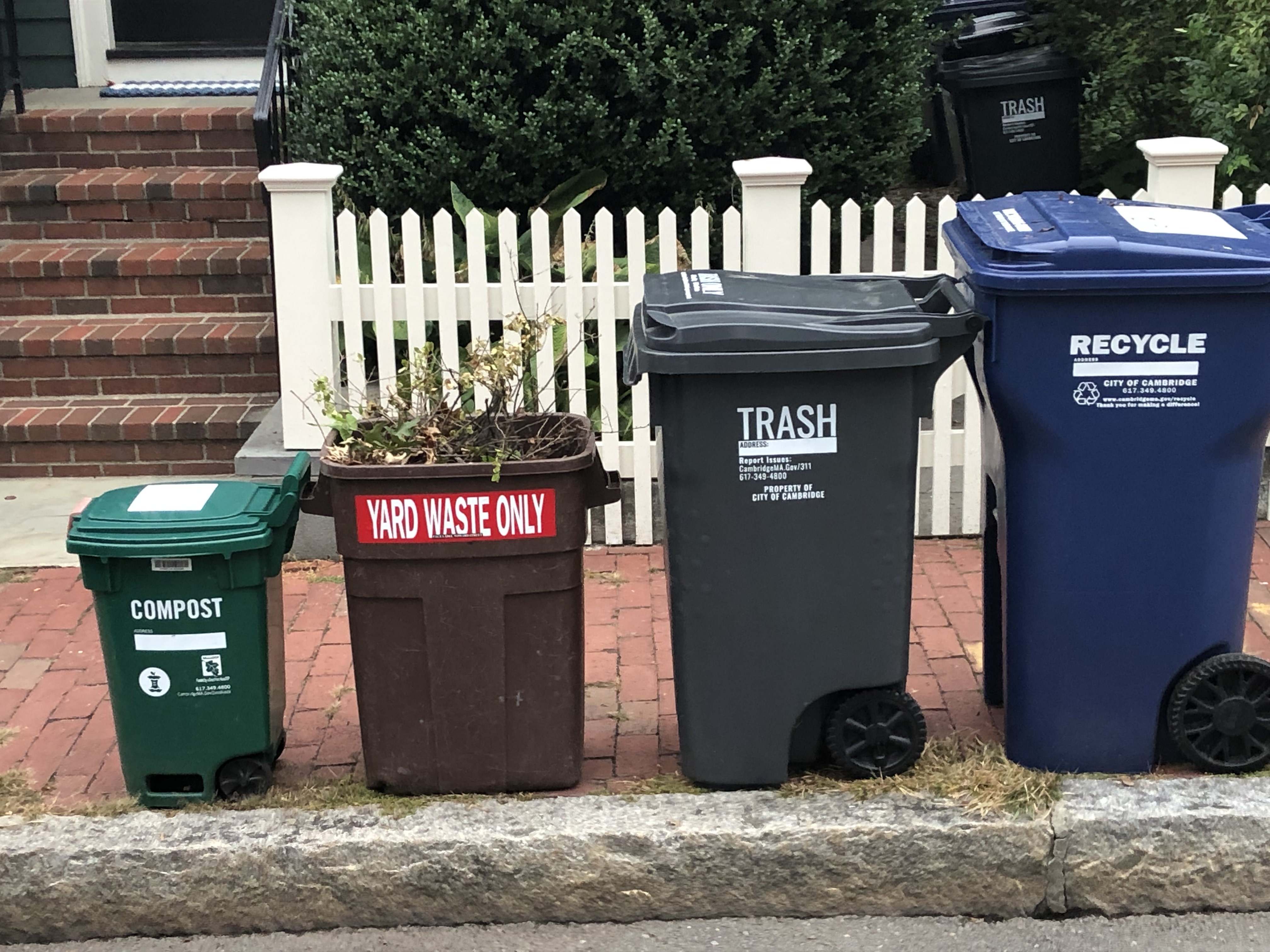
Waste Management & Policies:
Waste management and recycling policies in Cambridge are dictated by Municipal Code 8.24: Refuse & Litter Ordinance. All commercial, nonprofit, institutional and residential buildings in Cambridge must comply with the Ordinance and Rules & Regulations.
The Refuse & Litter Ordinance was revised in 2026 to reflect changes in the City and waste management trends. The changes are expected to improve cleanliness of the streets and sidewalks, reduce rodent activity, and address dwindling landfill capacity and increasing costs to trash our waste. The Ordinance changes take effect February 3, 2027. Property Owners and Property Managers are responsible for compliance. The two largest changes are:
- All buildings are required to separate food waste from their regular trash.
- Large residential (>13 units) and commercial buildings (>25,000 square feet) must submit Zero Waste Plans to document how their building is working with tenants to comply with the Refuse & Litter Ordinance.
Other Requirements (Both New and Current) for Waste Management in Cambridge:
- Other items banned from trash disposal: Recyclables, yard waste, textiles, mattresses, hazardous waste, and batteries.
- Property Owners and Managers must maintain waste carts and dumpsters.
- Lids of dumpsters and carts must be closed at all times.
- If there are signs of rodents accessing containers (i.e. holes in carts), owners are required to replace them within 15 days.
- If using City waste programs, property managers must also label carts with their address.
- The City may charge $50 to replace lost carts or carts chewed-through by rodents.
-
To maintain sidewalk accessibility, please follow these rules for placing carts out for collection.
- Carts must be at the curb by 7am on collection day (or after 6pm the evening before).
- Carts must be removed from the curb by 6pm on collection day.
Violations are subject to a fine up to $300 per day. DPW is taking an education-first approach to implementation. Our job is to make sure no one is penalized because they did not have the right information or support.
Tools and Assistance:
- Use the Get Rid of It Right tool to look-up how to dispose of items.
- To review all requirements, DPW has created this helpful checklist for building owners, property managers, and residents.
- DPW is offering free on-site technical assistance. Please fill out this form if interested.
- To learn about the City’s programs for managing recycling, food waste and more, visit here.
- For more assistance or questions, please email Recycle@Cambridgema.gov
Help with Compliance:
Until December 24, 2026 the Department of Public Works is accepting comments and feedback on the Rules and Regulations associated with the Refuse & Litter Ordinance. The Rules & Regulations are found at the end of the Ordinance text here
Other Waste - Related Ordinances:
- The Bring Your Own Bag (BYOB) Ordinance has been updated as of February 3, 2027. Plastic bags of any type are no longer allowed as a checkout bag. Retail stores may only provide paper or compostable bags as a checkout bag and the retailer must charge at least 10 cents per bag.
- Under the "Skip the Stuff" policy taking effect on February 3, 2027, foodservice businesses may provide single-use items such as napkins, utensils, and condiment packets only when customers request them.
- The Polystyrene Ordinance went into effect in 2016 and prohibits retailers and restaurants from dispensing food or beverages in polystyrene products.
Frequently Asked Questions
What other rules should residents be aware of?
More than 66% of citations issued by DPW are for residents putting waste barrels at the curb too early or leaving the carts out too late. This makes sidewalk accessibility an issue, particularly during the winter months. Please be sure to do the following:
- Carts can be placed at the curb after 6pm the evening before your collection day (or at the curb before 7:00 a.m. on collection day)
- Carts must be removed from the curb by 6pm on collection day.
- If your collection day is delayed due to a holiday, you must adjust set-out times. For example, if your trash collection day is Monday but there is a delay due to a Monday holiday, you may not place carts at the curb until Monday at 6pm for Tuesday collection.
How does separating food waste from trash reduce rodents?
Food waste is being generated and thrown out. The separation of food waste into locking green Food Waste carts make detecting food waste harder for rodents because the odors are sealed in.
Audits from DPW have reflected that trash carts are repeatedly being chewed through and green Food Waste carts are helpful at addressing rodents on private property. In 2022, more than 11,000 properties received new trash carts from DPW. Before the new trash carts, 45% of trash barrels had rodent-chewed holes in the bins. Between 2022 and 2024, the rate of trash carts with holes increased from 0% to 10%. By 2026, the rate increased to 19%.
Despite DPW replacing hundreds of trash carts for rodent chew-throughs, the rate of rodents accessing food waste in the trash is increasing. Meanwhile, the rate of holes in Food Waste carts hovers between 2% and 3% in each audit.By requiring the separation and collection of food waste in locking green carts, we can reduce our disposal costs, reduce our environmental impact, and thoughtfully address rodent issues.
How do I manage other forms of waste that are banned from the trash?
Use our Get Rid of It Right Tool to look up what to do with other waste items such as textiles, batteries, electronics and more. Or, download the Zero Waste Cambridge app (iOS|Android). Residents use it more than 300 times per day.
What specifically is allowed in the Bring Your Own Bag (BYOB) Ordinance?
Reusable bags at check-out are no longer permitted effective February 3, 2027. However, you may sell a reusable bag off the rack as merchandise.
What must my food establishment do to comply with the Skip The Stuff Ordinance?
Where do I find a hauler for food waste and other waste?
Otherwise, commercial buildings must contact a licensed hauler to inquire about waste collection services. See below for haulers licensed in Cambridge:
Casella Waste Services
CL Noonan Container Service
Classic Disposal LLC
DBI Waste Systems, Inc.
DNS Disposal, LLC
E.O.M.S. Recycling, Inc.
EL HARVEY & SONS INC
E-Z Disposal Service, Inc.
Northeast Recycling LLC
Pinto Recycling, Inc.
Republic Services
S&K Waste Services
Waste Management
Win Waste
Food Waste only haulers:
Bootstrap Compost, Black Earth Compost, Garbage to Garden, and Cero.
How do I complete my buildings' Zero Waste Plan?
Buildings can complete their Zero Waste Plan after January 1, 2027 in one of two ways:
- Complete the Zero Waste Plan along with your dumpster license renewal.
- Complete the Zero Waste Plan online here.