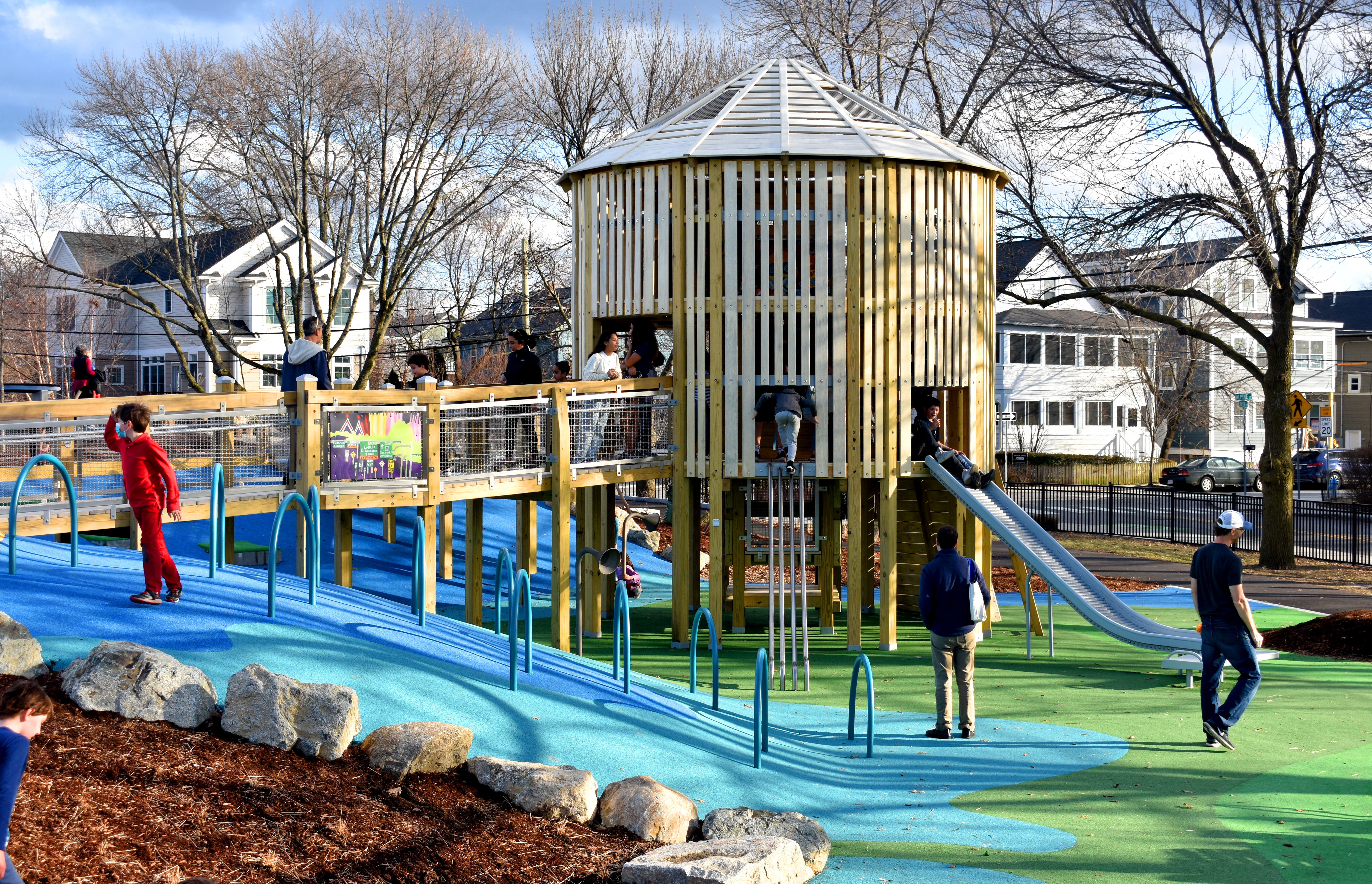
This fall marks the five-year anniversary of the opening of the Louis A. DePasquale Universal Design Playground at Danehy Park. Universal design means all parts are as usable as possible for everyone without adaptation. The design, led by Weston & Sampson, considers the widest range of physical, cognitive, sensory, and emotional experiences throughout the playground. Public art woven into the design of the playground celebrates the history of the site and diversity of voices that help to shape this exciting playground.
Here are five fun facts about the design of the playground:
Many aspects of the playground design draw inspiration from Danehy Park’s history.
Play structures reflect the industrial brick kilns and train cars used to transport bricks to construction sites. The public artwork and play sculpture, Pipe Dreams, draws on the more recent past of Danehy. Led by architect Ethan Lacy, high school students at the NuVu Innovation School noted the use of perforated underground pipes to manage landfill decomposition. They designed a structure shaped like a pipe with windows, handholds, and undulations. Its smooth wood surfaces invite climbing for all ages – inside the pipe, up the outsides, or perching on top.
The existing topography created opportunities for movement.
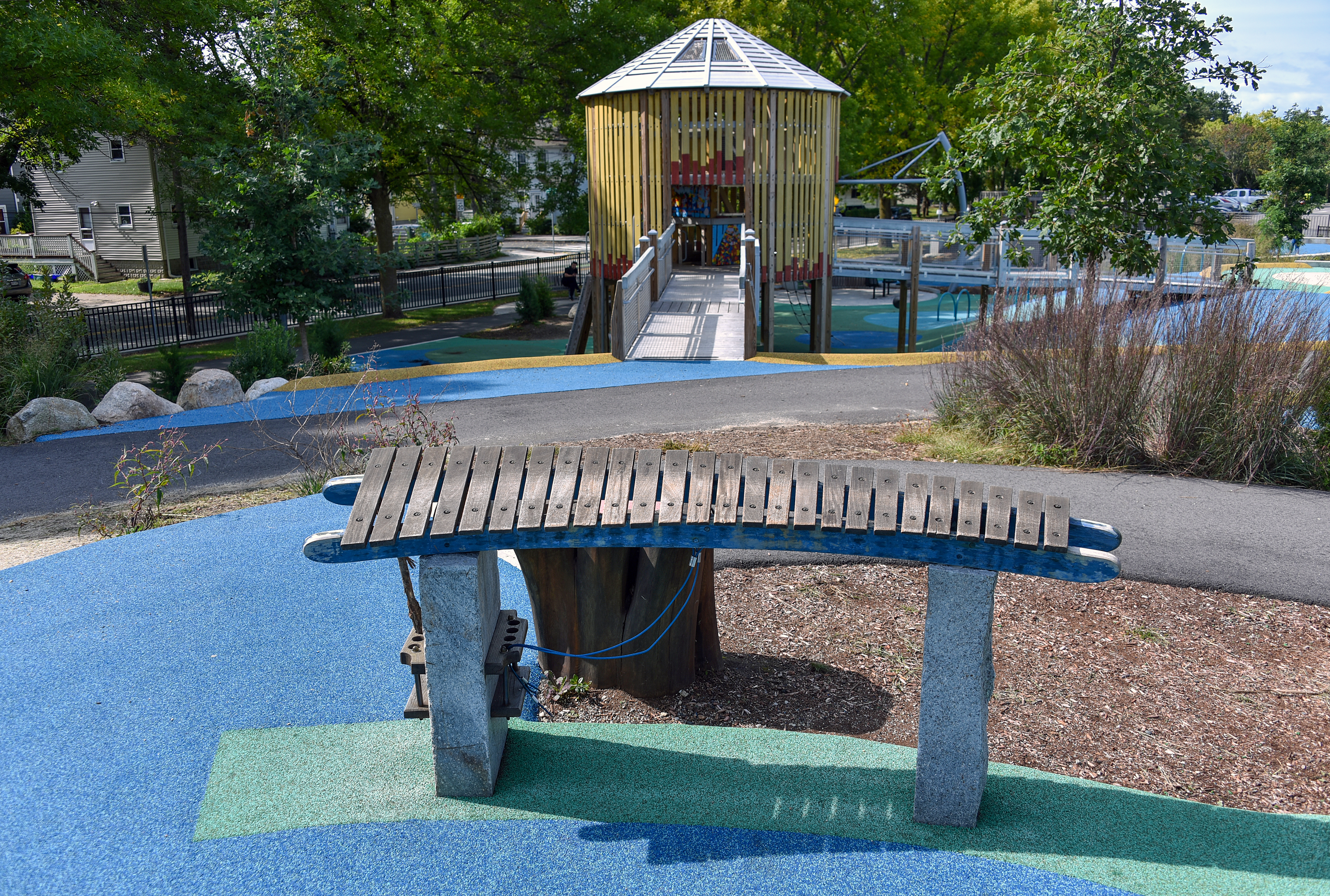
The site designers took advantage of the existing site topography to incorporate playful up-and-down free movement from one end of the playground to the other. It offers opportunities for elevated viewpoints. These are often limited by the amount of space needed for long ramps or platforms. The playground is able to include these through how the design team shaped the landscape. For his public artwork Sensory Hilltop, Cambridge artist Mitch Ryerson worked with the design team to design a winding accessible path to take you to the top of the hill. There, you can view the whole playground and beyond. There’s a shade structure, a marimba, log sitting stools, a Boston puddingstone boulder with a shallow polished dip that collects water after a rain, a bench with tactile features using copper inlay, and river stone texture under one’s feet.
The project gave new life to local trees.
As a master woodworker, Ryerson has built many popular play features for Cambridge playgrounds using local wood. This project was no exception. Ryerson used Black Locust logs gathered from the nearby Fresh Pond Reservation. Black Locust trees are native to the Appalachia but are invasive in New England. The trees were being removed as part of the Glacken Slope Restoration Project that was already underway. The project, which was part of the Fresh Pond Master Plan, helped stabilize the slopeside and bring back native plantings crowded out by invasives. Black Locust wood resists rot and does not splinter. Mitch was eager to use it rather than have it go to waste.
The design and layout of the park celebrate a variety of sensory and play experiences.
In addition to climbing structures, the playground provides a multitude of sensory experiences with motion, sound, texture, and touch. When one needs some refuge from the noisier active areas, there is a quiet path that offers ground textures and sound instruments to play. Plantings on both sides of the path engage one’s sense of sight, smell, and touch. Elsewhere in the park are structures geared towards “stimming” through swinging and spinning. The park also features a splash pad, which is a popular feature in parks for water play and keeping cool in the summer. However, not everybody that is visiting a playground is hoping to get wet. The design team was guided by the focus group in the decision to place the splash pad on one edge of the park. This location feels connected to the playground, but it is not so central that it’s hard for parents or caretakers to avoid if they want to keep kids dry for the day.
The park reflects, benefits from, and celebrates our community’s diversity.
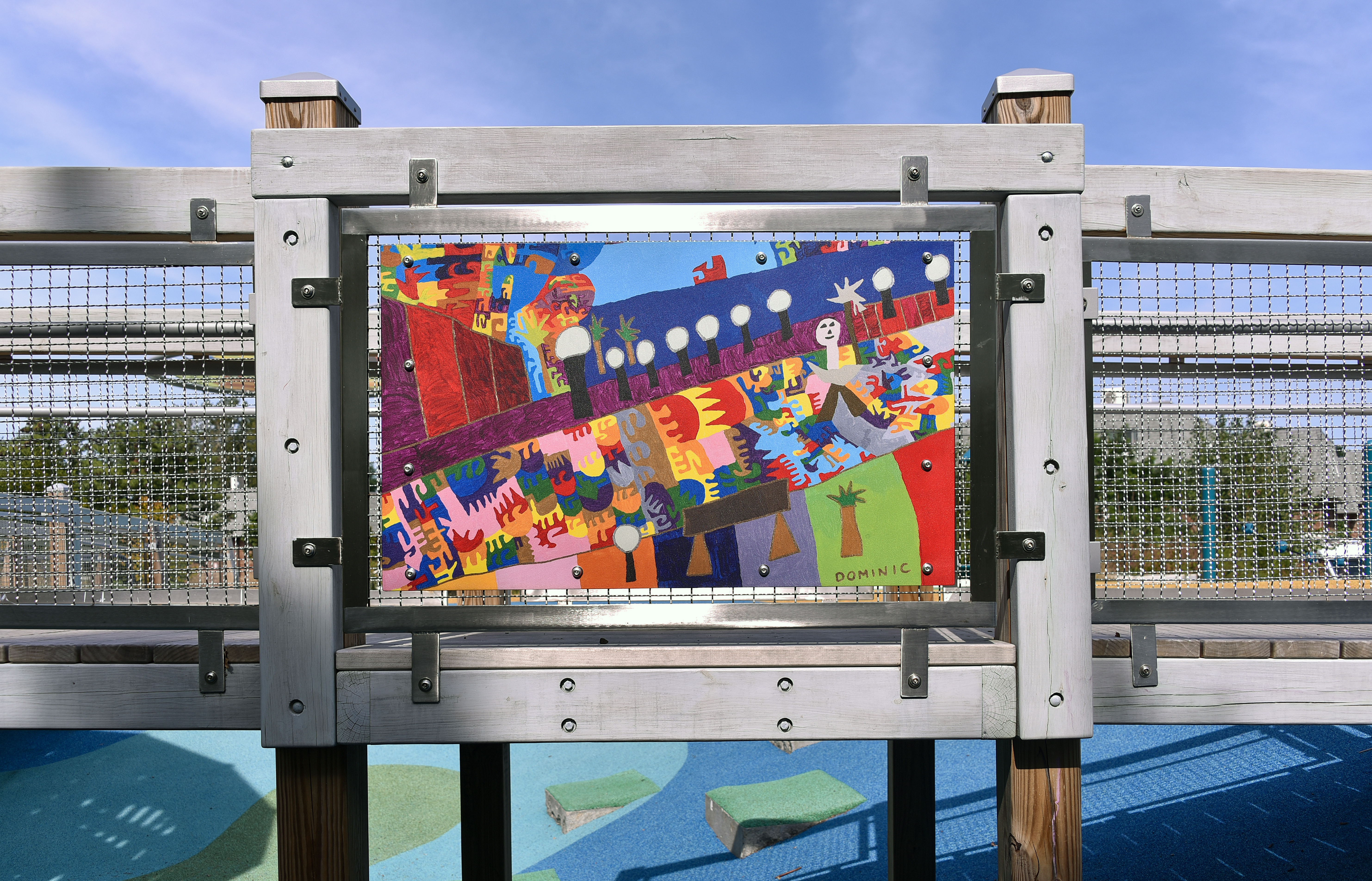
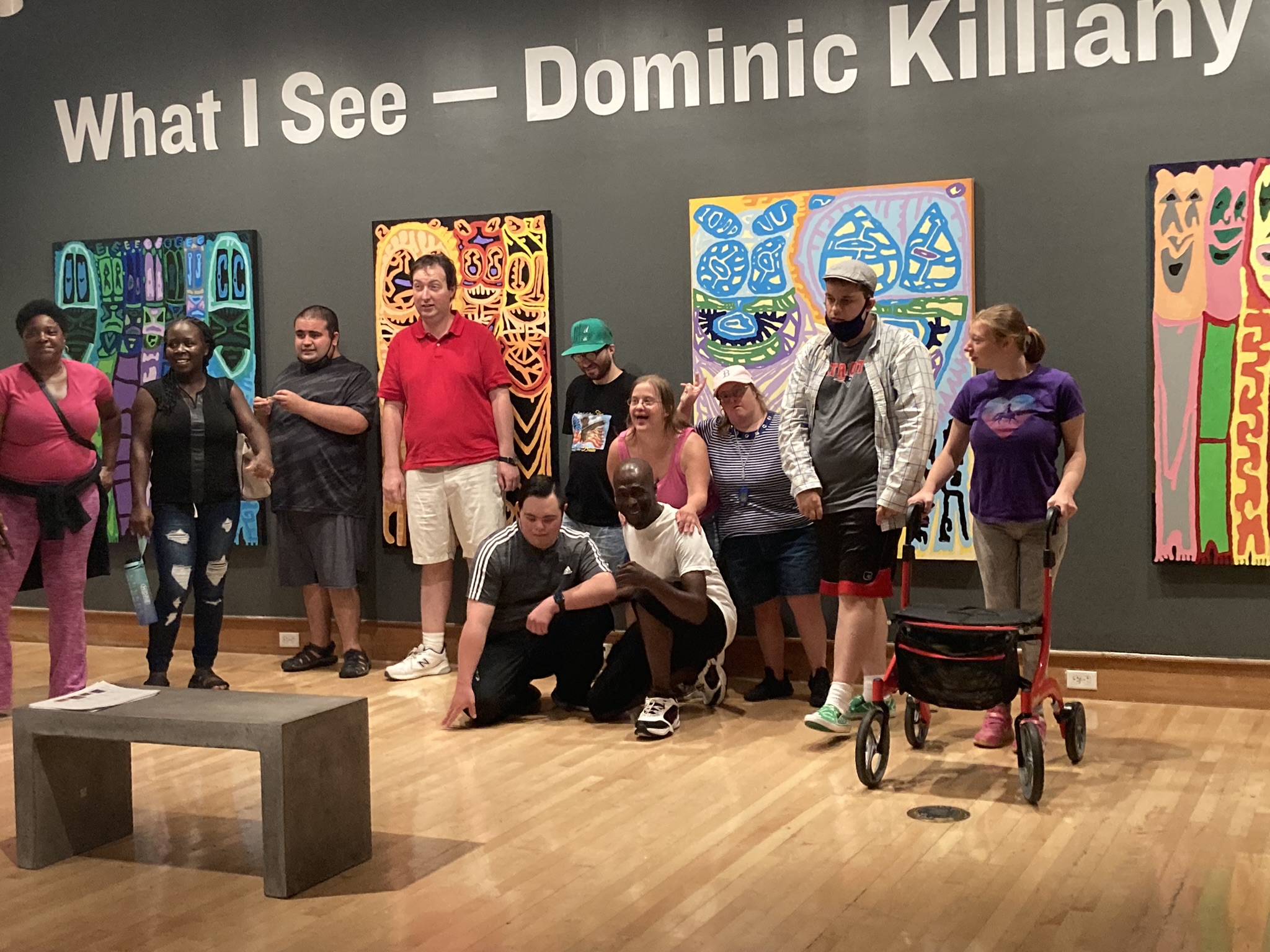
The focus group represented different backgrounds and experiences. This range of voices was critical to the success of the playground and design process. They helped the design team and City staff shape a space that celebrates differences in how we experience the world—not as obstacles to overcome, but as ways to realize more rich, vibrant places that all can enjoy. This sense of celebration is also a part of ten artwork panels throughout the playground. Dominic Michael Killiany is a prolific young painter living with autism who finds his subject matter in whatever captures his curiosity: sights around Boston, photos he sees in magazines, his own imagination. In his own words, Dominic's art is “his visual poetry and connection to the world.” Ten of his pieces were translated into durable material and mounted at select locations around the playground. These pieces enliven the play space and bring vibrant color—and Dominic’s experience of the world—into a play space that celebrates our diversity as a community.