An Interview with the Cambridge Commission for Persons with Disabilities Office
The Americans with Disabilities Act (ADA) was signed into law on July 26, 1990. The ADA is a federal civil rights law protecting people with disabilities against discrimination. In honor of the historic milestone of the 35th anniversary of the ADA, we’re interviewing Rachel Tanenhaus, ADA Coordinator for the City of Cambridge and Executive Director of the Cambridge Commission for Persons with Disabilities (CCPD), and Kate Thurman, Assistant ADA Coordinator and CCPD’s Deputy Director, about the ADA’s impact on the disability community.
How does the ADA impact the lives of people with disabilities?
The ADA protects people with disabilities from discrimination in the following areas:
- Employment: individuals with disabilities are protected from discrimination in all aspects of employment, including hiring, training, promotions, and compensation. The ADA also requires employers to provide reasonable accommodations to enable disabled employees to do their jobs.
- State and local government: public entities must make their programs, services, and activities accessible to people with disabilities. This includes public transportation like the MBTA.
- Places of public accommodation: places such as restaurants, stores, hotels, and medical facilities — private businesses and nonprofit organizations — are prohibited from discriminating against people with disabilities.
- Telecommunications: this provision of the ADA requires telephone and internet companies to provide relay services for people with hearing and speech disabilities. The ADA created the nationwide system of telephone relay services for Deaf and hard of hearing people and those with speech disabilities.
But the ADA isn’t just a law — it’s a declaration that people with disabilities are entitled to the same rights, opportunities, and dignity as everyone else.
How does your office and work interact with the ADA?
We are the ADA Coordinators for the City. We answer questions about people’s rights and responsibilities under the ADA. We serve as subject matter experts and collaborate with all City departments to ensure that the City complies with and, wherever possible, exceeds the requirements of the ADA. We are also here as a resource for Cambridge residents, businesses, and nonprofits on ADA and disability-related matters.
Have you been personally impacted by the ADA?
Rachel: I had my first job interview ever two months before the ADA was passed — I was sixteen and applying to be a camp counselor. The person interviewing me said she liked my interview responses but didn’t think a blind person could take care of children. Of course, there are blind parents all over the world, so she was both wrong and ableist. Fortunately, she quit and someone else decided to hire me, but she would not legally have been able to discriminate against me like that today. I’m a hard worker, but I need accommodations that cost money in order to do my job. An employer can’t decide to hire someone less qualified than me just because they don’t want to pay for my accommodations. I’m also a guide dog user, and the ADA gives me the right to participate in all the same things everyone else does without being kicked out for having a guide dog. I have a pretty active life, so that’s a big deal.
Kate: My life has been impacted by the ADA in more ways than I’ll probably ever know. Because I was a child when the ADA was passed into law, I’ve never faced employment or any aspect of adult life without those protections in place. I’ve had many reasonable accommodations in my jobs over the years that have allowed me to thrive in my work. Additionally, I have had a service dog by my side for nearly 20 years; it’s very rare that I’m refused service or entry to businesses for having my service dog with me, but I’m able to cite my ADA-protected rights when it does happen. The ADA and resulting inclusion have helped to normalize disability as the natural human experience that it is. As a member of the disability community, I’m seen more as a human with basic civil rights and less as someone having health issues that need to be fixed. 35 years of the ADA has had a huge impact in shifting these cultural perspectives!
What do you want people to know about the ADA?
Rachel: Some people think of the ADA as a trap that gets businesses sued or a bothersome set of building codes. It is literally a civil rights law. Or they think it’s just about installing ramps, which is important but not the whole story. Design professionals who create accessible spaces are using their power to decide who is and is not welcome in a space to fight against bigotry and exclusion. Businesses that embrace accessibility aren’t being charitable; they’re taking down a giant, metaphorical “Keep Out” sign. Doctors’ offices that ensure that patients get interpreters and accessible information are following their oath to do no harm, because otherwise people with disabilities don’t get health care and sometimes die from that lack. It’s that simple.
It is sometimes life and death. It’s not a favor. It’s the bare minimum. And I want people with disabilities to know that these are rights, not privileges. Just because our civil rights have an “undue burden” clause doesn’t mean that we are burdens.
Kate: While the ADA was designed to remove barriers from everyday life for people with disabilities, it’s had far-reaching impacts that benefit everyone. Have you ever seen caregivers pushing strollers or delivery drivers rolling their carts up or down a curb ramp? You can thank disability advocacy and the ADA for those ramps! Every automatic door opener, caption, elevator, option for workplace flexibility makes life easier for all of us. Additionally, virtually everyone who has the privilege of living long enough will experience disability at some point, whether temporary or permanent.
Disability is a universal and natural human experience, and accessibility isn’t just a disability issue; it’s a principle of inclusion that lifts all of us!
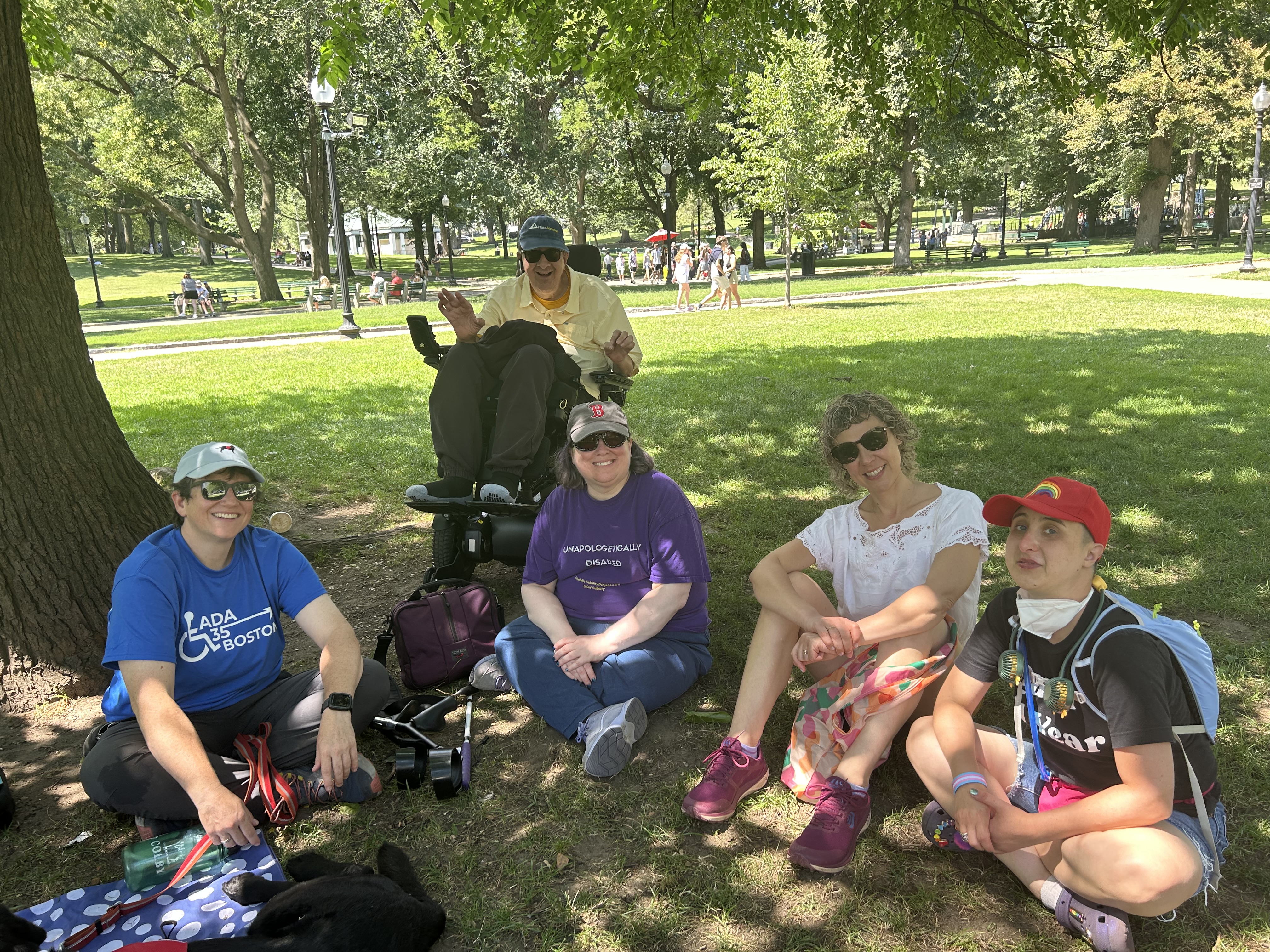
Photo Caption: Kate Thurman (left) and Rachel Tanenhaus (middle) enjoy the Boston Common with other leaders and advocates in the Greater Boston disability community at the ADA35 Rally and March.