


Participatory Budgeting is Back!
How would you spend $500,000 to improve Cambridge? Submit your Ideas by October 11, 2026!

Official websites use .gov
A
.gov website belongs to an official government
organization in the United States.
Secure .gov websites use HTTPS
A
lock (
) or https:// means you’ve safely connected to
the .gov website. Share sensitive information only on official,
secure websites.

Participatory Budgeting (PB) in Cambridge is back for its 13th cycle, and the City wants to hear your ideas for projects! How would you spend $500,000 to improve our community? See guidelines for PB projects below. Looking for inspiration? Visit our PB Cycles tab to take a look at the projects that have won in PB in the past! Submit your ideas before October 11, 2026.
To be eligible for PB funding, projects must:
Have you ever wondered how the ideas become projects on the ballot? All ideas are reviewed by volunteer Cambridge residents, the PB Delegates! PB Delegates work alongside other community members to research, review, and develop submitted ideas into the 20 projects the community sees on the ballot in March. Learn more and sign up to join for this year!
PB13 Cycle Timeline
PB Cycle 13 Timeline
Participatory Budgeting (PB) is a democratic process where community members can vote to directly decide how to spend part of a public budget. PB was first developed in Brazil in 1989 and is now used in over 7,500 cities around the world.
In Cambridge, PB aims to directly involve residents in the budgeting and city-building process, foster civic engagement and community spirit, and help ensure that the City’s budget reflects the priorities of Cambridge residents and local partners. Cambridge residents have allocated more than $11 million to over 80 PB projects since 2014. Learn more about the past PB Cambridge cycles on our PB Cycles page.
Sign up for PB email updates here!
Curious about what's won in the past? View all the ballot and winning projects on the PB Cycles tab!
Participatory Budgeting (PB) is a democratic process where community members can directly decide how to spend part of the City’s budget.
In Cambridge, community members begin by submitting their ideas for projects on how to spend the PB budget. Then, volunteer Cambridge residents, called PB Delegates, work alongside other delegates, Cambridge community members, and City staff to develop all the submitted ideas into 20 project proposals. The 20 project proposals are then presented to the public through a city-wide vote. Top vote-getting projects win funding and are implemented by the City in the following fiscal year.
The City hopes that Participatory Budgeting will directly involve residents in the budgeting and city-building process, foster civic engagement and community spirit, and help ensure that the City’s budget reflects the priorities of Cambridge residents and local partners.
The Outreach Committee approved the following five goals for the PB process:
The PB13 budget is $500,000. This funding will come from the City's Fiscal Year 2028 (FY28) budget. Projects are eligible for funding if they meet the following criteria:
Before being submitted to the public vote, all projects must be approved by City staff to ensure they meet the requisite need, impact, and feasibility criteria, and that they meet all legal requirements of capital and operating projects. PB project funding is part of the City's annual budget. If you are interested in learning more about the City's overall budget and budget process, please visit the Budget Office website.
Operating Projects fund programs and services, including salaries. Multi-year operating PB projects can win funding for a maximum duration of three years. Once PB project funds are spent, the project will end. Cambridge’s 10th PB cycle was the first year operating projects were eligible for PB funding consideration. Many City services like trash and recycling collection, animal control, the Fire Department, and Cambridge Public Schools, involve operating funds.
Capital Projects fund infrastructure improvements, typically things that are bought or built. Most capital projects have some sort of associated operating cost, like the ongoing cost to maintain and clean a public bathroom. Capital projects could include open space amenities, transportation infrastructure, vehicle purchases, technological materials, and much more. Examples of previous PB capital projects include youth center upgrades, electric vehicle charging stations, basketball court upgrades, water bottle filling stations, and tree plantings.
Learn more about the City’s FY27 Operating and Capital Budgets.
The 13th PB cycle will run from August 2026 - March 2027 and include the following key phases:
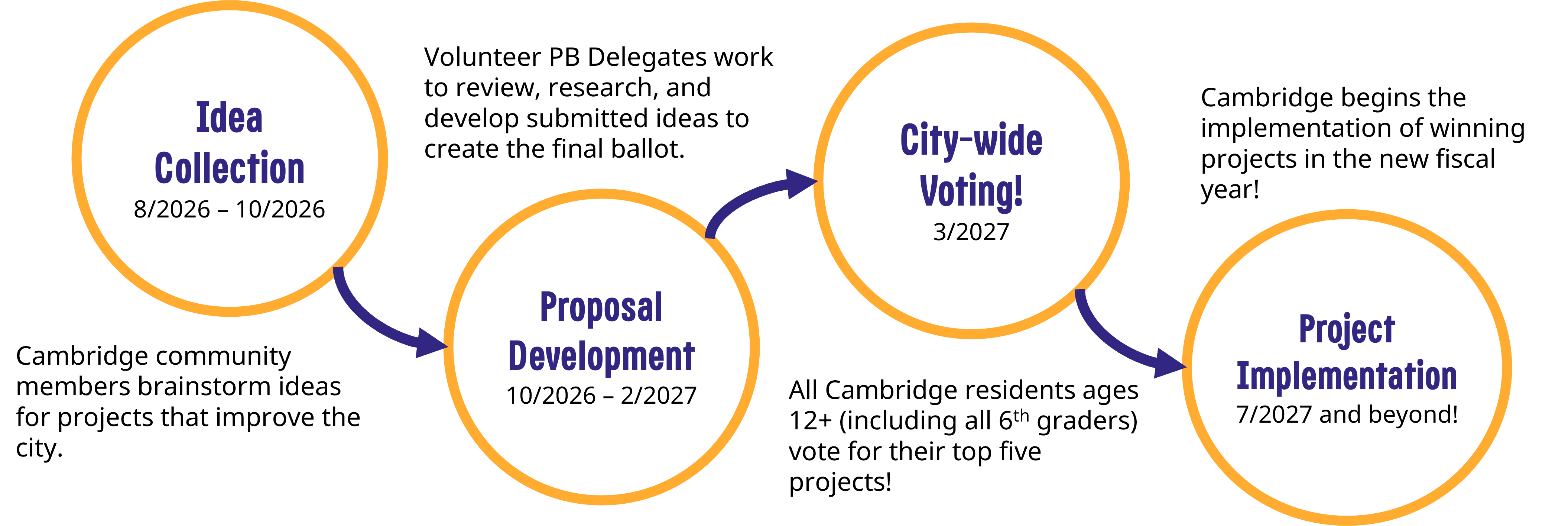
PB Delegates are volunteer Cambridge residents who work in teams to research, evaluate, and prioritize the project ideas submitted by community members during idea collection. PB Delegates work for three months to develop and choose the final project proposals for the PB vote in March. The proposal development process involves site visits, community assessments, and consultations with City staff to evaluate a project's need, impact, feasibility, and cost.
During the PB12 process, 70+ PB Delegates worked in the following four committees to narrow down over 1,100 submitted PB ideas into 20 final project proposals for the ballot: Community Resources, Environment, Parks & Recreation, and Transportation Streets & Sidewalks.
If you are interested in volunteering as a PB Delegate, visit the Volunteer page for more information and the sign up form.
The PB13 vote will be open in March 2027. All Cambridge residents who are at least 12 years old (as well as students in the 6th grade), regardless of citizenship status, are eligible to vote in Participatory Budgeting. College/university students whose dorm/apartments are in Cambridge are also eligible to vote. Voters will be able to choose up to 5 of the 20 projects on the PB13 ballot. They do not need to rank their choices or do any math.
The PB13 online ballot will available in English, Amharic, Arabic, Bengali, Chinese, Haitian Creole, Hindi, Japanese, Portuguese, and Spanish starting in March 2027.
Residents can also vote over the phone in English at (617) 349-4270 and in-person at multiple events around Cambridge. Paper ballots at in-person events will be available in English, Amharic, Arabic, Bengali, Chinese, Haitian Creole, Hindi, Japanese, Portuguese, and Spanish.
You can read about winning projects from the last PB cycle here.
More information about the City’s budget can be found online on the Budget Office website at www.cambridgema.gov/budget.
As a governmental entity, the Massachusetts Public Records Law applies to records made or received by the City. Any information received through use of this site is subject to the same provisions as information provided on paper.
Read our complete privacy statement
Enter a service request via SeeClickFix for things like missed trash pickups, potholes, etc., click here