What is a Civic Assembly?
A Civic Assembly is a group of community members who gather to learn about an issue, talk about it thoughtfully, and make recommendations to the Cambridge City Council.
Members are selected by lottery from among residents who volunteer to participate. The selection process is designed so that the Assembly is broadly representative of the community it serves.
Assembly members do not need any special knowledge or expertise to participate. They hear from experts, advocates, and organizations with different perspectives, consider evidence and the experiences of other residents, ask questions, and work together to develop informed recommendations for the City Council.
How do I become a member of the Civic Assembly?
First, you must receive and respond to a mailed invitation by September 27, 2026. We are sending invitations by mail to 15,000 randomly selected households in the City.
You can volunteer in any of the following ways, if you received an invitation in the mail:
When registering online or by telephone, please have the unique keycode on your invitation card ready.
If you are selected through the Civic Lottery, you will be notified by October 10, 2026.
Please hold all four Assembly dates in case you are selected in the lottery to participate. Selected Assembly members must be able to participate in all four sessions from 9 a.m. - 4 p.m.
- October 24
- November 7
- November 21
- December 5
Why is Cambridge holding a Civic Assembly?
The Cambridge City Council has recently considered questions concerning the use of surveillance technologies for public safety, including ShotSpotter gunshot detection technology and videosurveillance cameras in Cambridge public parks.
These technologies raise important questions about public safety, effectiveness, cost, privacy, civil liberties, equity, and public trust. The Cambridge City Council has called for a Civic Assembly to provide recommendations concerning how Cambridge should approach using these technologies in the future.
The Assembly gives a more representative group of Cambridge residents the time, information, and support needed to examine these questions in greater depth and provide advice to the City Council.
What is the mandate of the Civic Assembly?
The Civic Assembly will consider whether, how, and under what conditions the City should use gunshot-detection technology, such as ShotSpotter, and overnight video surveillance of public parks in its approach to public safety, including what rules, safeguards, and oversight should govern their use.
Why these technologies, and not others?
Assembly members have four Saturdays to learn about, discuss, and develop their recommendations. A narrow task will help members do the difficult work of learning, reaching consensus, and writing thoughtful and useful recommendations for Cambridge.
The City of Cambridge uses surveillance technologies for a variety of purposes beyond public safety and law enforcement, such as for public health and traffic management.
In early August 2026, Council asked for recommendations on two technologies: gunshot-detection technology and surveillance cameras (specifically for use in public parks overnight). This Assembly responds to those requests.
The mandate is meant to focus, but not limit, discussion. Assembly members may discuss other surveillance technologies that the city uses or could use. The Assembly’s eventual recommendations may be applicable to other surveillance technologies.
What will Assembly members do?
Over four Saturdays, Assembly members will learn and work together to develop recommendations for Cambridge City Council.
Members will have opportunities to:
- learn about surveillance technologies currently or potentially used in Cambridge;
- understand how technologies such as gunshot detection systems and surveillance cameras work;
- hear from experts and organizations with different perspectives;
- consider evidence and experiences from Cambridge and other communities;
- learn about public safety, privacy, civil liberties, equity, cost, effectiveness, and public trust;
- hear from other Cambridge residents; and
- deliberate with one another and develop recommendations for the City Council.
The Assembly will meet from 9:00 a.m. to 4:00 p.m. on:
- October 24, 2026
- November 7, 2026
- November 21, 2026
- December 5, 2026
The meeting location will be confirmed before the Assembly begins.
What will happen to the Assembly’s recommendations?
At the conclusion of the Assembly, members will provide their recommendations to Cambridge City Council.
The City Council will consider the Assembly’s recommendations and deliberate on how best to incorporate them into future City policies concerning public safety and surveillance technology.
The Assembly is advisory. Final decisions remain the responsibility of City Council.
How will members of the Civic Assembly be chosen?
The 40 members of the Cambridge Civic Assembly are chosen via a multi-step process. This process is random, aiming to give everyone a fair chance of participating; it also ensures that the final assembly is representative of Cambridge’s population. The selection process is depicted in the image below, with a description underneath.
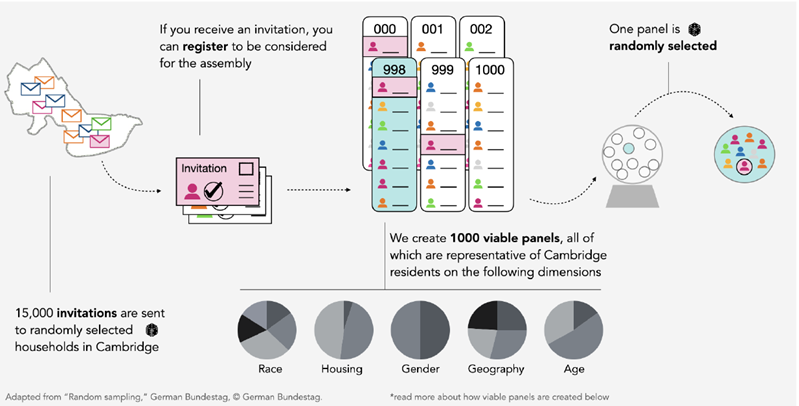
Random invitations. The process began by mailing out 15,000 invitations to random Cambridge households. Records with the same address, ZIP Code, and ZIP+4 were combined so that each unique address had only one chance to be selected.
This produced a list of 52,424 unique addresses. A computer-based (AI was not utilized) random selection process then selected 15,000 addresses without replacement, meaning an address could not be selected more than once. Every address on the final list had the same chance of being selected.
The random starting value used by the computer was established and recorded before the results were reviewed. This makes the selection reproducible and prevents someone from repeatedly running the process until they obtain a preferred result.
After the addresses were selected, each received a unique invitation code. The invitation codes were assigned separately and had no influence on which addresses were selected. One recipient per household can then enter the lottery to be chosen for the assembly.
Choosing the assembly by lottery. After collecting all invitation responses, we then select the 40 assembly members (the “panel”) by lottery. This lottery is done by first creating 1000 possible panels. Each of these panels is a viable set of assembly participants: each contains 40 people and satisfies representation requirements ensuring that the panel reflects Cambridge’s population demographically and includes a diversity of lived experiences related to the assembly topic.
We design these 1000 panels – instead of simply choosing 40 people directly from invitation respondents – to make the process random: the final assembly is selected by lottery from among these 1000 possible panels. Importantly, the panels are constructed carefully to ensure that everyone who signed up has a chance to be selected, and no one is given too much chance of being selected. The procedure used to compute these panels is based on several years of research (done in part by local researchers at Harvard and MIT), and it mathematically guarantees that we achieve the properties described above.
Notifying the chosen panelists. Once the official panel is randomly drawn, volunteers on the selected panel are notified, and the assembly can begin.
Note:
- The City of Cambridge has partnered with Bailey Flanigan, assistant professor in MIT's political science and computer science departments on the sortition process.
- It is not possible to give all volunteers exactly equal chances of selection, because certain groups sign up at higher rates than others. However, our procedure is designed to make these chances as equal as possible.
Why are Assembly members randomly selected?
People who attend public meetings are not always representative of the broader community.
Random selection helps bring together residents with different backgrounds, experiences, and perspectives, including people who might not otherwise volunteer for a City committee or public process.
This can help the Assembly better reflect the community as a whole.
Who is eligible to serve on the Civic Assembly?
To be eligible to participate in the Assembly, you must:
- Live in Cambridge.
- Be 16 years of age or older.
- Have received a mailed invitation with a unique code on your postcard to proceed.
- Be available to participate in all four Assembly sessions from 9 a.m. – 4:00 p.m.:
- October 24, 2026
- November 7, 2026
- November 21, 2026
You do not need to be a U.S. citizen to participate.
Who is ineligible to serve on the Civic Assembly?
To protect the independence and impartiality of the process, some people whose professional or official roles are closely connected to the work of the Assembly are not eligible to serve.
These include:
- current elected officials and their staff;
- employees or representatives of organizations or contractors directly involved in advising the City concerning surveillance technologies being considered by the Assembly.
If you are unsure whether you are eligible, please call the Assembly information line at 617-349-5580.
I don’t know anything about surveillance technology or policing. Can I still participate?
Yes. Assembly members do not need to have specialized knowledge about surveillance technology, policing, or government.
Your perspective and experience as a Cambridge resident matter most.
The Assembly is designed as a learning process. Experts, facilitators, and people with different perspectives will help members understand the issues, answer questions, and consider the evidence before developing recommendations.
Will I be paid to serve on the Assembly?
Yes.
Each Assembly member will receive a $1,000 stipend upon completing the Assembly in recognition of their time and public service.
The City will also provide meals and refreshments during Assembly sessions and work with members to reduce barriers to participation. This will include support for childcare and eldercare support, transportation assistance, and reasonable accessibility accommodations, as needed.
Can any member of my household volunteer?
Yes.
Each mailed invitation can be used by one eligible person age 16 or older who lives at the address where the invitation was mailed.
If you cannot participate, please consider passing the invitation to another eligible member of your household.
Only one person from your household may register using the unique keycode provided with this invitation.
I’m not sure whether I can attend all four sessions. Can I still volunteer?
Assembly members must be available to participate in all four Saturday sessions from 9:00 a.m. to 4:00 p.m.:
- October 24, 2026
- November 7, 2026
- November 21, 2026
- December 5, 2026
Please consider your availability carefully before volunteering.
Candidates will be notified by October 10 if they have been selected. Until then, please hold all four dates in your calendar.
If you cannot attend all four sessions, please consider passing this invitation to another eligible member of your household.
Who is organizing the Civic Assembly?
The Civic Assembly is an initiative of Cambridge City Council and City Manager.
The Assembly is being organized in collaboration with FIDE North America, a trusted advisor to local and state-level governments seeking to involve everyday people in shaping public policy. They are a nonpartisan and issue-neutral nonprofit organization that advances Citizens’ Assemblies through training, design, and evaluation.
Partnering with the City of Cambridge, they are helping provide technical guidance, lead design and building the City’s capacity to deliver this first-ever civic assembly.
The FIDE team is working under the direction of the City's Director of Community Engagement Jackson Price, in coordination with City and local partners, throughout the design, implementation, and reporting phases of the process.
Do I need to speak or understand English to participate in the Civic Assembly?
You do not need to speak English to participate in the Civic Assembly. The City is committed to language justice and will provide language support so that Assembly members can participate meaningfully in the language they are most comfortable using.
The City will work with Assembly members to identify the language support and communication methods they need. This may include translated materials, live interpretation, and other communication supports.
The City prioritized English, Spanish, Haitian Creole, and Portuguese in outreach for the Assembly because these are the most commonly spoken languages in the Cambridge neighborhoods most impacted by gun violence. Assembly members may request support in additional languages or other communication methods as needed.