Join Neighbors and City Staff at the Park Party and Project Open House!
Join neighbors and City staff Wednesday, September 16th from 4 PM – 7 PM at Hoyt Field for a Park Party and Project Open House!
Stop by anytime during the event for:
- Free food and drinks (vegetarian and halal options)
- Project information
- Important community feedback
- Face painting
- Family-friendly games
Can't make the event? The Summer 2026 Survey is still open for your feedback!
Summer 2026: Take the Hoyt Field and Park Survey!
The City is just beginning a community conversation about how to improve Hoyt Field and Park.
We’re inviting you to:
- Share your stories and memories of Hoyt
- Tell us what you like about Hoyt
- Offer ideas for what should change

Your feedback will help shape how we renovate the park in the future.
Spring/Summer 2026: Getting Connected and Seeing the Big Picture
The most important part of this phase is connecting with you!
We want to make sure that as we prepare for design, that people who care about Hoyt and that will be affected by the design are a part of shaping what happens.
We also want to start getting some big picture direction of what you think Hoyt should be. Is the mix of what’s there a good fit for what we want? Are there things that are especially important or meaningful to you, that we should be celebrating? Are there things that are missing?
Here's are some ways we can get connected:
-
Take the Hoyt Field & Park Survey!
- Your feedback will help shape how we improve the park.
- Sign up for Email Updates
- This will be one of the main ways we share updates on this work, as well as other ways to share feedback and connect with us!
- Find us at the park and at events!
- We’ll be doing outreach at the park throughout the summer. Look for our schedule in the coming weeks!
- Are you hosting an event you want us to know about? Reach out to Lev McCarthy at lmccarthy@cambridgema.gov!
-
Sign up for Virtual Office Hours
- Sign up for virtual office hours appointment to discuss the project with the City team.
Have other ideas? Reach out to the project team! You can contact:
Lev McCarthy
Neighborhood Planner
lmccarthy@cambridgema.gov
For more information on what to expect throughout this process, click the Schedule tab at the top of this section.
We will be doing community engagement throughout the project. There are different goals for each stage, but, at every point, we want to make sure you know what is happening at the time and how you can help shape the park!
Spring/Summer 2026: Getting Connected and Seeing the Big Picture
The most important part of this phase is connecting with you!
We want to make sure that as we prepare for design, that people who care about Hoyt and that will be affected by what happens here are a part of shaping what happens.
We also want to start getting some big picture direction of what this park is and should be. Is the mix of what’s there a good fit for the community? Are there things that are especially important to you, that we need to make sure we celebrate? Are there things that are missing?
Fall 2026/Winter 2027: Getting Ideas Down and Hearing What You Prefer
This is when we will turn what we’ve been hearing into design ideas to get your feedback. This works best when we can bring people together to hear from each other.
You can expect community meetings , but we will have other approaches to get feedback as well.
Do you have suggestions for how we can get feedback on the design? Let us know!
By the end of this time, we hope to know what types of features will be in the park.
Spring/Summer 2027: Testing Things Out and Getting the Details Right
At this time, we will be creating the construction documents for this project. These are technical documents that describe the specific details of the park.
The construction contractor we hire will use these documents to build the park.
We may use this time too to test out some of the design ideas to make sure what we’re capturing is the best fit for the park.
We'll also be getting close to construction starting, and want to get people ready for parts of the park to be closedand to celebrate the work that you’ve done in shaping the park design!
Fall 2027/Spring 2028: Hiring a Contractor and Starting Construction
This is when we expect we can bringing on a contractor and start construction. At this time, we do not know exactly how long construction will take. This will be a long construction process. But, we expect this work to be done in phases, and that large parts of the park can remain open for use while construction is happening.
Sign up for email updates, and check back on this website for updates.
We will be refining the specific project area as we do early outreach and engagement.
At minimum, we know we will make improvements to both of the playground areas and the surrounding paved path areas around the park.
We plan to work with neighbors and park users to understand early on if some of the existing parking spaces at the park may be more valuable as space for other park amenities neighbors would like to see instead, or if they are important to keep as parking.
We expect that the courts and most of the field area will not be changed as a part of this project. We may make repairs or resurface court areas as needed as part of this work, but expect that they will remain as part of the final park design.
In the fall of 2025, City staff worked with young people at the Cambridge Community Center on a project called “Hoyt Through Your Eyes.” Students spent part of the afternoon around the park taking photos—of what they saw, of their experiences, of what makes Hoyt special to them. They were then asked: if they could share only one photo of Hoyt what would it show? Back in the classroom, they selected their favorite photos and wrote a caption describing what’s in the image and sharing why it’s important.
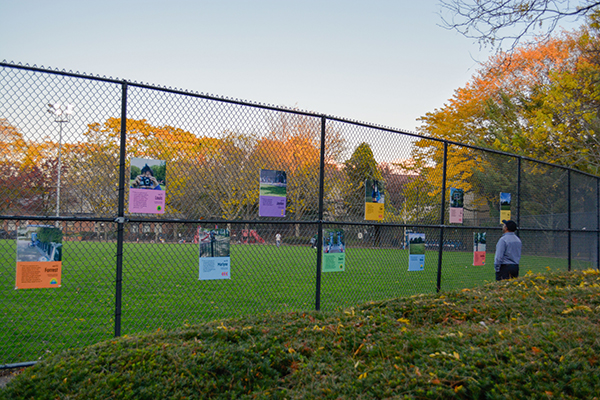
You can visit the park to view a gallery of photos, and click here to share your own photo and caption with the project team! Throughout this project, we hope to expand the gallery to share other experiences of the park!
A new shade canopy created with input from Cambridge residents is located near the basketball courts. The colorful structure, titled A Little Cooler, features community-designed flags that highlight local stories and collective creativity. Designed by architect Justin Brazier and Calvin Zhong, the canopy sits near the basketball court and offers both comfort and a welcoming gathering space during the hottest months of the year. Brazier, working with the AGONY collective and steel researcher Juliana Berglund-Brown, repurposed steel columns from a dismantled water tower to give new life to salvaged materials.
A Little Cooler is one of many temporary public art installations launched in 2024 through the City's Shade Is Social Justice initiative, which uses art and design to spark dialogue about climate resilience and help residents prepare for extreme heat. This effort complements broader City initiatives such as reducing fossil fuel use in large commercial buildings, expanding electric vehicle charging, and improving biking and transit infrastructure. Shade Is Social Justice began with a $100,000 Accelerating Climate Resiliency grant from the Metropolitan Area Planning Council and now includes additional City and mitigation funding from New England Development to support more artists and sites.
The City will be using Community Preservation Act (CPA) funds for the majority of the Hoyt Park renovation project. This will be done through a combination of funding that has already been approved, as well as planned future requests to the City's Community Preservation Act Committee in 2026 and 2027 to put together the full budget for this project. These requests are submitted to the Committee for their evaluation, and if recommended by the Committee, go before the City Council for approval. We also expect to use other capital funds for Phase 2 of this project.
The Community Preservation Act was created by state law to help cities and towns preserve the character of their community.
In 2001, Cambridge residents voted to adopt the CPA locally, which allowed the City to implement a 3% surcharge on Property Tax bills to fund eligible projects. CPA funding can be used to support projects in three categories: open space (and recreation); historic preservation; and community housing. The Commonwealth of Massachusetts provides "matching" funds in addition to those raised locally by the surcharge.
Click here to learn more about the CPA process in Cambridge and the work that it has funded in our community.