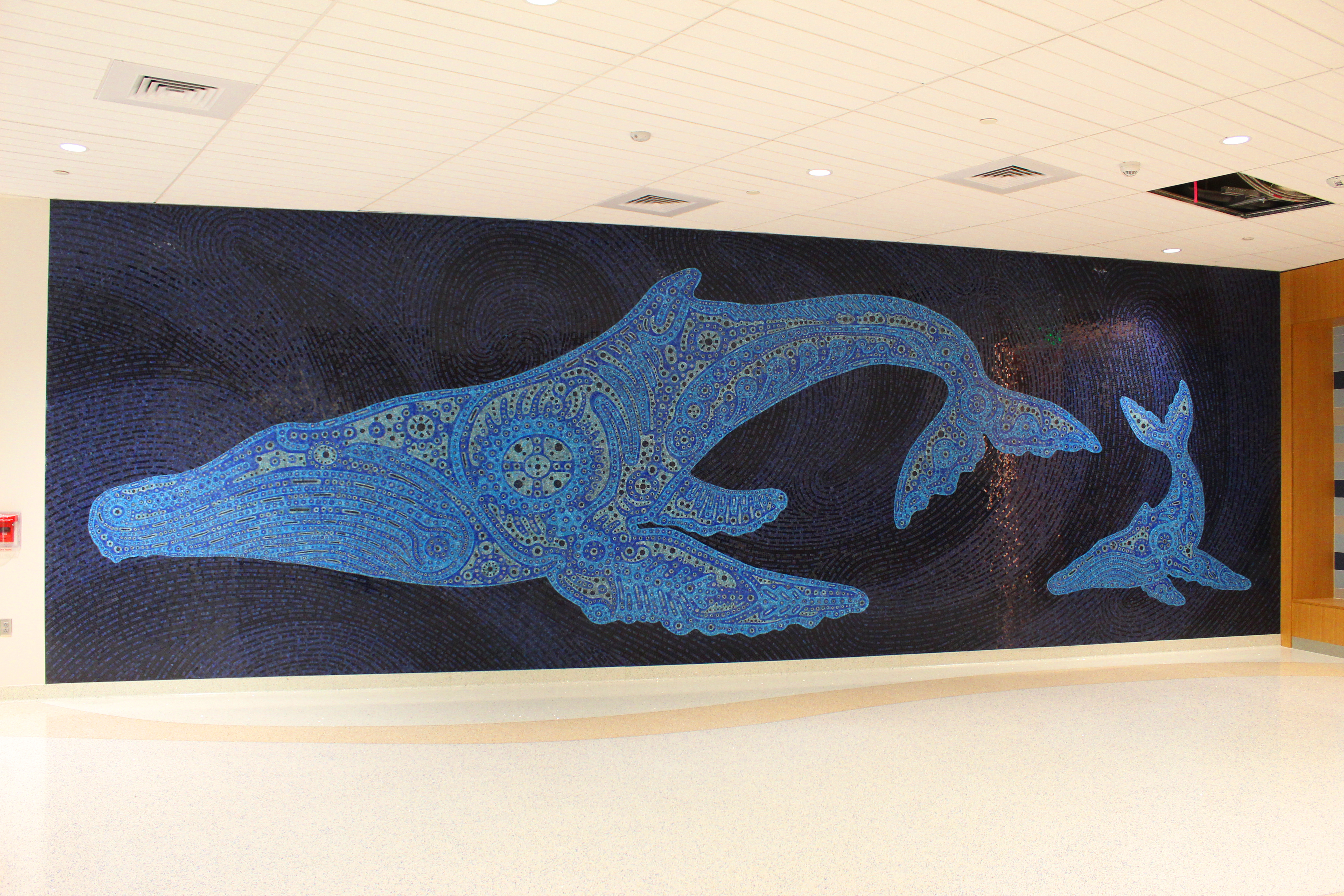
Among the many features of the new Tobin Montessori and Darby Vassall Upper Schools, one wall stands out: "Tranquility," a mosaic of a humpback whale and its calf created by Cambridge-born artist Andromeda (Annie) Lisle. A graduate of Cambridge Rindge and Latin School, Lisle has built a career rooted in her love of animals, biology, and mythology, drawing on her Cherokee, Black, and Irish heritage as well as artistic traditions ranging from Eastern Woodland Indigenous to Celtic and West African. Through her work, she explores themes of community, nature, and mutual support. We spoke with Lisle about what it means to leave a lasting mark in the schools where she grew up, her journey as an artist, and her hopes for the students who will encounter her work every day.
Q: Could you tell me a little bit about who you are and your background as an artist?
Andromeda (Annie) Lisle: I'm of mixed heritage. My family is comprised of Cherokee, Black, and Irish descent. I was raised with cultures and stories from all of my backgrounds from my mother. I was raised mostly just by my mother for a long time, and she is an artist herself, so she always encouraged my own art, and that's helped it flourish. And I've always been a deep fan of animals, biology, zoology, as well as mythology. Sometime in college, it clicked to combine the two, especially regarding Eastern Woodland indigenous mythology, because I deeply respected the roles that animals have played for humanity and humanity's stories. So, I started focusing my art on that. And I wanted my style to honor my background, so I did a lot of studying on ancient styles used by people around the world, but also from my own heritage. So, you know, from Celts, from Eastern Woodland, from West African countries. The style that you see me use professionally is a combination of that, just like how I felt they combined into me. I also like to involve my love of biology and zoology in those. That means alluding to things like cellular activity or structure, and the way that we're built on the inside; we're made up of small things that make up bigger things, that make up bigger things, that make up us. It plays into that, also into that belief system that a lot of cultures and indigenous people have that we're all part of this world. We're on even ground, no one is better than anyone else, we all have a role to play in this world, what we do affects the world, and what the world does affects us. It's a cycle that feeds into itself. That's why you'll see a lot of circles and organic shapes in my pieces. And then sometimes I'll allude to the anatomy of the animal I'm painting, so it all kind of built up over years and years.
Q: You grew up in Cambridge and graduated from CRLS. How did your time in Cambridge shape you, both personally and artistically?
AL: Oh, immensely. My art teacher at CRLS, Deborah Haverty, was extremely vital for my development as an artist. She provided a lot of support. She always went above and beyond, and it really helped keep me on track and focused on developing my art. Cambridge, in general, has always been extremely friendly towards the arts. At times it can be very difficult to find opportunities to expand your horizons, like getting that first mural commission can be really difficult, but the city is much more conducive to growing yourself as an artist than a lot of places.
Q: Could you tell me about the inspiration behind the whale mural at the Montessori Vassall Upper Schools?
AL: It was three-fold. My very first mural, which was commissioned by the Harvard Ed portal, was of a whale, but much smaller. I was inspired by the local, indigenous cultural hero Moshup, who is a giant, but is able to transform into a whale, and he is a central part of the regional mythos, so I wanted to honor him as well. I chose the humpback whale because around here, humpbacks mean a lot to a lot of people. They're an important cultural icon for the Northeast, not even just Massachusetts. People love watching them, people love studying them, and I do personally think they're the most beautiful whale. And thirdly, whales are one of the few animals that spend an extremely long time caring for their young; they devote a lot of energy to just one or two calves. They spend years and years raising and teaching them and showing them how to live in their world. And I thought that was a good reflection for being in a school where the adults there are going to be guiding those kids at an extremely important and vulnerable point of their lives and giving them the tools to survive in our world. So that's why, when I designed it, I included the calf behind the whale to represent both the adult teachers and staff and all of the people that make up a support team in a school that are guiding the children to give them the best tools they can to live a good life.
Q: What does it mean to you on a personal level to create something that will happen in the schools in Cambridge?
AL: It means a lot. I'm disabled, I collect Social Security, I rely on a lot of social services. And so, I'm unable to work as much as your average person, and I've always wanted to give back in some way to thank my community for helping support me all this time. The mosaic was a perfect way to do that for me. It was like a beautiful opportunity that benefits me, but it also benefits the community that helped me grow. It was just a cycle of reciprocity that I was really happy to be able to do because I know you're not like required to give back, but it's good energy to. And I always felt it's important to show your appreciation and gratitude for the good things that happen.
Q: What do you hope that both students and teachers will feel when they see the mural every day in school?
AL: I hope they feel what I named the piece, tranquility. Blue is my favorite color; I rely on blue to be calming, to be soothing. I wanted to impart that, especially in these modern times, people need help to relax and reflect now more than ever. So, I want people to see it and feel calmed and comforted, that kind of thing.
Q: Do you see this project as part of a larger story about representation, community, or even cultural identity in Cambridge, but also universally?
AL: Oh, yeah, absolutely. And like I said before, I wanted to evoke a sense of community and show people, especially the kids, that you're not alone in this world. You know, the people around you are the people who will help you, and you can rely on them. Like, there's real people really right here for you if you need them. Sometimes it can be very difficult to reach out, but it's a part of life, having to do that.