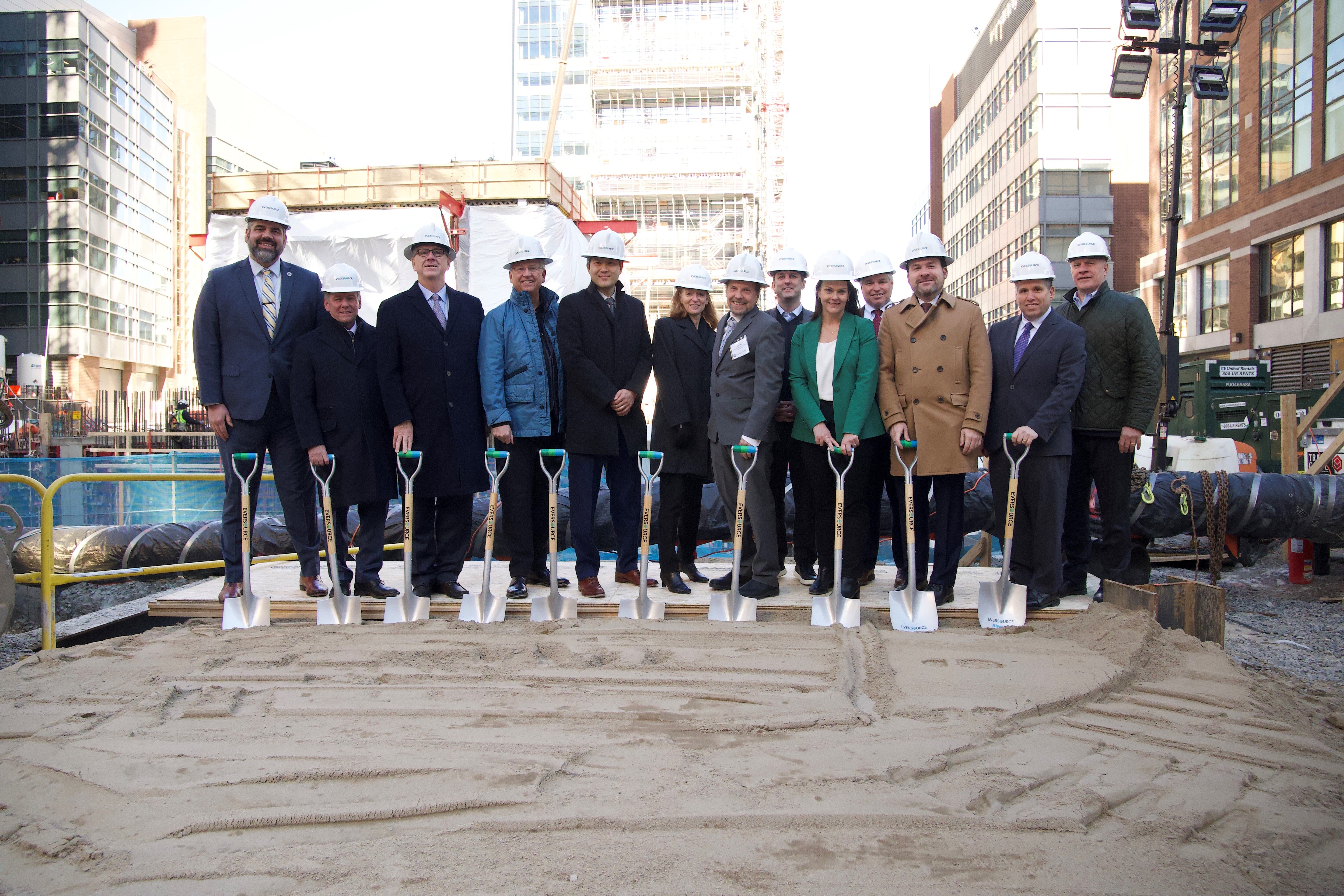
On a crisp morning earlier this year in Kendall Square, shovels of dirt flew as city officials, community partners, and Eversource representatives gathered to celebrate something both groundbreaking and history-making. Beneath the cheers and speeches was the start of a project unlike anything built before in the U.S.: the Greater Cambridge Energy Program (GCEP), a massive investment in the region’s energy future — and it’s all happening underground.
Where once stood a parking garage, there will soon be green space, cutting-edge lab buildings, and — hidden 105 feet below — the largest underground electrical substation in the country. At 35,000 square feet, this facility will quietly power the daily lives of residents and businesses, while freeing up space above ground for community use.
The new underground substation will be joined by eight new underground transmission lines interconnecting to existing substations in the surrounding area. The project is expected to bolster system reliability, meet growing energy needs, and further facilitate access to clean energy resources.
“This is a creative solution that shapes a more sustainable and resilient energy future,” said Eversource CEO Joe Nolan at the ceremony. “By working hand in hand with Cambridge and our partners, we’re meeting today’s needs while preparing for tomorrow’s clean energy transition.”
Why It Matters
The City is moving away from fossil fuels and more residents are installing electric heat pumps, electric vehicles are increasingly being purchased and driven on our streets, and entire buildings are being built as fully electric. That progress comes with a challenge: the grid needs to keep up.
The GCEP is designed to do just that. Once online, the underground substation will have enough capacity to electrify all residential heating in Cambridge and replace up to half of the commercial sector’s gas demand with clean electric systems. It will also make room for more renewable energy.
“This project is about reliability, resiliency, and responsibility,” said Cambridge City Manager Yi-An Huang. “We’re ensuring that as our community grows, the power system grows with us — and in a way that supports our decarbonization goals.”
A First-of-Its-Kind Design
Instead of rising above ground, the substation will be hidden underground, tucked beneath new green space between Broadway and Binney Street. Above, neighbors and visitors will enjoy a welcoming park and cutting-edge science facilities. Below, the lights, heat, and technology of the future will hum with power.
“The CRA and the City of Cambridge turned a planning challenge into an opportunity,” said Tom Evans, Executive Director of the Cambridge Redevelopment Authority. “What was once a parking garage will become a vital energy hub, a space for discovery, and a place for the community.”
Beyond Cambridge
The substation is just one piece of the puzzle. The GCEP includes eight new underground transmission lines running 8.3 miles through Cambridge, Somerville, and Boston, upgrades to five substations, and nearly 50 new distribution lines. Together, this network will ensure that electricity can flow reliably where it’s needed most — whether it’s to a family’s new EV charger, a biotech lab’s climate-control system, or a new apartment building designed for all-electric living.
Building Toward the Future
The project is expected to come online in phases, with the first elements ready by 2029 and full completion by 2031. Along the way, it will support roughly 500 full-time jobs and bring steady activity — and anticipation — to Kendall Square.
For Cambridge residents, the payoff will be felt in everyday life: a more resilient power system that keeps the lights on during storms, supports clean technologies, and helps the city move further away from fossil fuels.
“The GCEP is about more than wires and transformers,” said Bryan Koop of BXP. “It’s about powering the future of Cambridge in a way that makes space for people, for science, and for community.”
As the groundbreaking shovels were set aside and the crowd dispersed, the scale of the project — and its promise — lingered. The work ahead will be complex and years in the making, but its impact will stretch far beyond Kendall Square. For Cambridge, the future of clean, resilient energy is being built right beneath its feet.